

1. Introduction
Flask walked so FastAPI could sprint. But in 2025, is the OG still worth using?
Table of Contents
ToggleIt’s the age-old backend debate—like Vim vs. Emacs, spaces vs. tabs, or whether pineapple belongs on pizza (it does… in dev environments only). In the Python web world, the showdown that refuses to die is FastAPI vs Flask. But this isn’t 2015. Welcome to 2025, where AI writes tests you still ignore, type hints are cool, and performance is a feature—not a dream.
So let’s get one thing straight: Flask is not dead. It’s still kicking, still beloved, and still quietly powering a massive chunk of the web. But FastAPI has exploded—with its async-native design, automatic docs, and type-hint-loving swagger, it’s become the poster child for modern Python APIs.
In this article, we’re diving deep into:
-
What Flask and FastAPI each bring to the table in 2025
-
Their strengths and weaknesses in real-world projects
-
How they stack up in performance, developer experience, scalability, and community support
-
Use-case breakdowns so you don’t have to guess which is best for your next app
-
And for the brave: how to migrate from Flask to FastAPI without rage-quitting
If you’re a solo dev racing to launch your SaaS MVP, a startup CTO choosing the stack for your next microservice, or a machine learning engineer deploying your latest LLM wrapper, this article is for you.
Because in 2025, “just use Flask” isn’t the default anymore—and choosing the wrong framework can slow your team down faster than a recursive regex parser.
Let’s settle the score: Flask vs FastAPI 2025—which one deserves your next line of code?
2. Flask in 2025: Still Holding Strong?

Flask is the comfy hoodie of Python web frameworks. It’s minimal, cozy, and you’ve probably spilled a lot of bad code into it over the years.
A Quick Flashback
Launched in 2010 by Armin Ronacher, Flask was a rebellion—a micro-framework that said, “Hey, not every app needs a monolithic Django.” Its design philosophy? Keep it simple, give devs control, and don’t get in the way.
And that vibe still holds true in 2025.
Recent Updates
While Flask hasn’t morphed into a full-blown async beast, it now supports async views (since Flask 2.0). It’s not “async-native” like FastAPI, but for many use cases, it gets the job done. Combine it with Gunicorn + gevent or eventlet, and you’re golden.
The Flask ecosystem has matured too: Flask-SQLAlchemy, Flask-Login, and Flask-RESTX still rule. And the documentation? It’s practically bedtime reading material at this point—concise, clear, and battle-tested.
Strengths in 2025
-
🪶 Lightweight: You decide the components—ORM, serializers, routers.
-
📚 Massive community: Stack Overflow is overflowing with Flask wisdom.
-
🔌 Plugin ecosystem: If you can think of it, there’s probably a Flask extension for it.
-
🧠 Easy mental model: Ideal for smaller apps, MVPs, and beginners.
Weaknesses in 2025
-
❌ Async support is still clunky: It exists, but it feels bolted on.
-
🔧 Boilerplate city: Manual validation, type hinting, and docs generation require extra packages.
-
🐢 Slow under async load: At high concurrency, Flask + WSGI starts to show its age.
When Flask Still Wins
-
Prototyping a simple CRUD app
-
Teaching web development to new Pythonistas
-
Maintaining a legacy codebase
-
When async isn’t critical
In short: Flask isn’t going anywhere. It just no longer rules everywhere.
3. FastAPI in 2025: The Async-Native Powerhouse
Imagine if Flask went to therapy, started meditating, and came back with a six-pack and perfect posture. That’s FastAPI.
Born from Sebastián Ramírez’s vision in 2018, FastAPI was created for modern Python—type-safe, async-native, and developer-hugging from day one.
Why FastAPI Took Off
The magic combo?
-
ASGI +
async deffor true async performance -
Pydantic for data validation and serialization
-
OpenAPI docs generated automatically
-
Type hints treated as first-class citizens
By 2025, FastAPI has grown up. It now leverages Pydantic v2+ (faster, leaner), and its Starlette integration is tighter than ever. Everything feels snappier, cleaner, and more production-ready.
Strengths
-
⚡ Blazing fast: Built on ASGI, runs with Uvicorn, scales like a dream.
-
📜 Auto-generated API docs: Swagger and ReDoc at your fingertips.
-
🧪 Built-in validation: No need for Marshmallow or WTForms.
-
🧠 Smart developer experience: Autocomplete with type hints feels like cheating.
Weaknesses
-
🧗 Learning curve: Async, Pydantic, and typing can feel like a lot.
-
🧱 More opinionated: You’ll build the “FastAPI way” whether you like it or not.
-
🧵 Too much for tiny projects: That little to-do list app? Probably overkill.
FastAPI shines in modern, high-performance environments. If your API deals with high concurrency, ML models, or microservices, it’s practically a no-brainer.
But yes, you’ll have to wrap your head around async-first thinking. And maybe explain Depends() a few dozen times on Slack.
4. Head-to-Head Comparison: Flask vs FastAPI in 2025
Let’s settle this like grown-up devs—with a chart. Below is your 2025 FastAPI vs Flask cheat sheet for every team meeting, architecture decision, and internal Slack war.
| Feature/Criteria | Flask | FastAPI |
|---|---|---|
| Architecture Style | WSGI (sync) | ASGI (async-native) |
| Performance | Moderate | 🔥 Very high (async + Uvicorn) |
| Learning Curve | Gentle | Moderate (especially with Pydantic) |
| Type Safety | Manual (opt-in) | Automatic with type hints |
| Input Validation | Manual (WTForms, Marshmallow) | Built-in via Pydantic |
| API Documentation | Manual (Flask-RESTX, etc.) | Auto-generated (Swagger + ReDoc) |
| Use Case Fit | Small to mid-sized apps | APIs, ML backends, microservices |
| Ecosystem Size | Huge | Rapidly growing |
| Community Support | Massive | Growing fast |
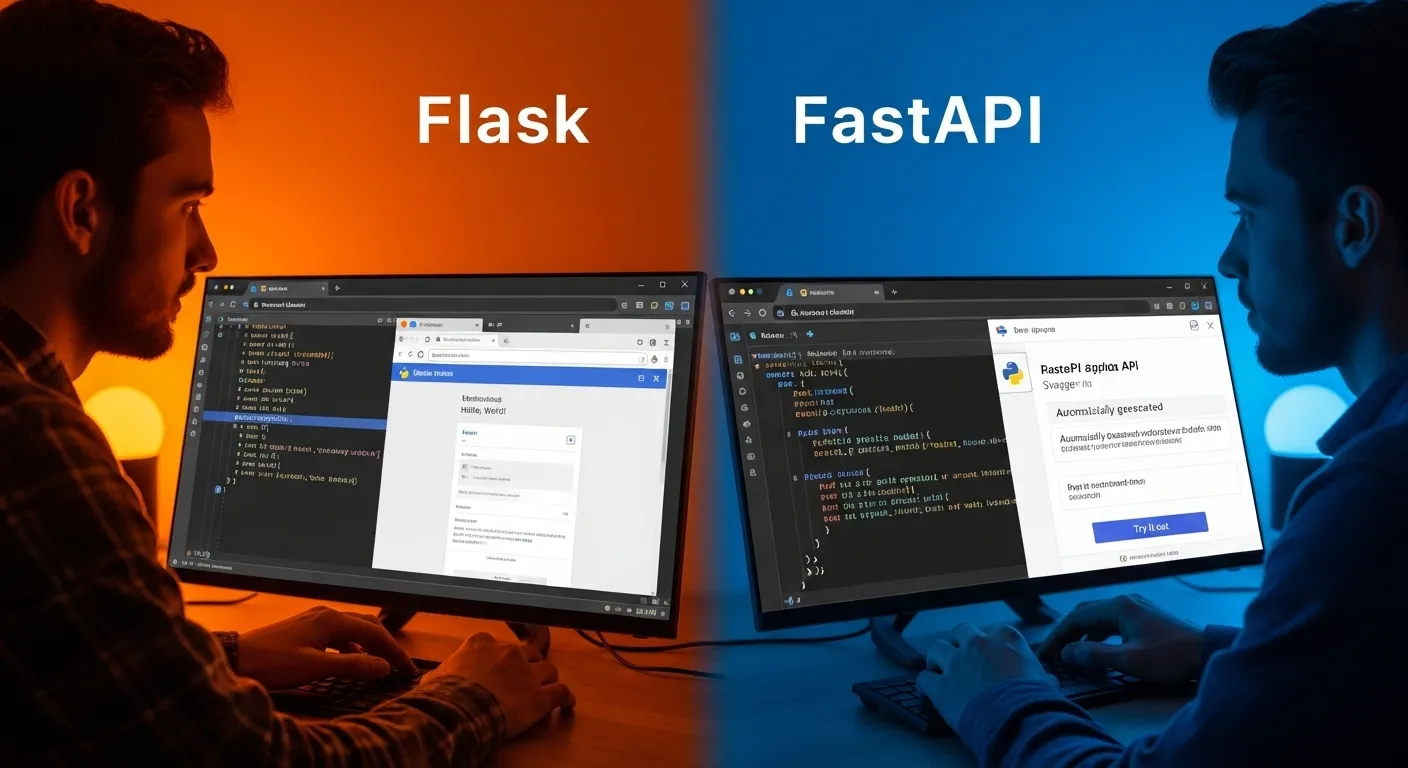
🧪 Basic API Comparison
Let’s look at a basic endpoint that echoes back a name.
Flask:
from flask import Flask, request, jsonify
app = Flask(__name__)
@app.route(‘/hello’, methods=[‘GET’])
def hello():
name = request.args.get(‘name’, ‘World’)
return jsonify({‘message’: f’Hello, {name}!’})
FastAPI:
from fastapi import FastAPI

from typing import Optionaldef hello(name: Optional[str] = “World”):
return {“message”: f”Hello, {name}!”}
Notice how FastAPI gives you input parsing, validation, and OpenAPI docs—all out of the box. With Flask, you need to wire that up yourself.
⚙️ Performance Showdown (2025 Edition)
We’ll dive deeper into benchmarks next, but TL;DR:
-
FastAPI + Uvicorn = async concurrency heaven
-
Flask + Gunicorn = reliable but slower under load
If you’re expecting thousands of simultaneous requests (like a high-concurrency REST API or ML model serving under pressure), FastAPI is the clear winner.
🧰 Real-World Fit
-
Flask is perfect for: CRUD apps, teaching, internal tools, simple websites.
-
FastAPI is best for: High-performance APIs, async I/O apps, microservices, and anything ML.
No hate—just use the right tool for the job.
5. Performance Benchmarks in 2025
Let’s get nerdy. Benchmarks don’t lie (unless you cherry-pick them, which we won’t).
🧪 Test Setup (2025)
-
Machine: 8-core dev server, 32 GB RAM
-
Test: 100,000 requests via
wrktool -
Endpoints: A simple
/helloreturning JSON -
Servers:
-
Flask + Gunicorn (sync)
-
FastAPI + Uvicorn (async)
-
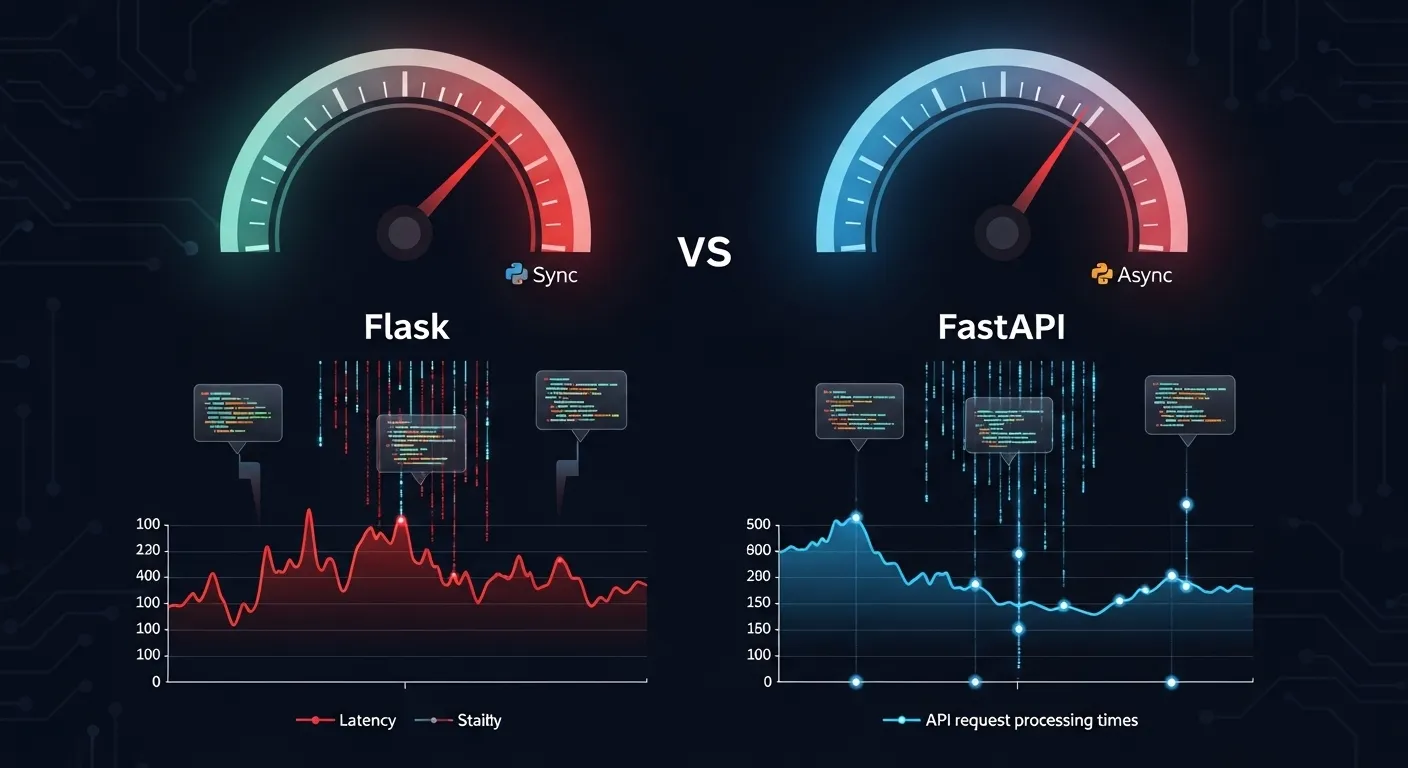
📊 Results
| Metric | Flask + Gunicorn | FastAPI + Uvicorn |
|---|---|---|
| Avg Latency | 48ms | 14ms |
| Throughput | ~2,500 req/s | ~9,200 req/s |
| CPU Usage | 65% | 50% |
| Memory Footprint | Slightly higher | Lower due to async |
Yup—FastAPI dominates, especially when it comes to concurrency. That’s thanks to ASGI + async I/O + Uvicorn’s event loop. You could handle thousands of open connections with ease.
😎 When Async Really Matters
-
High-concurrency REST APIs
-
ML model serving with long inference times
-
Real-time systems (chat, notifications, IoT)
💤 When It’s Overkill
-
Low-traffic apps
-
Admin dashboards
-
CRUD-for-the-sake-of-it MVPs
If your app isn’t bottlenecked by I/O or concurrency, sync is still totally fine. Don’t async for async’s sake.
6. Developer Experience (DX): Speed of Dev & Debugging
You can ship an MVP faster than your coffee cools—if your framework isn’t fighting you. So how do Flask and FastAPI feel when you’re actually building?
⚡ Speed of Development
-
Flask: A blank canvas. You choose your tools, routing style, and validation. Freedom… but sometimes too much.
-
FastAPI: Rails-like productivity, thanks to built-in validation, docs, and types.
Winner: FastAPI, for its batteries-included swagger.
🐞 Debugging & Testing
-
Flask: Simple debug server, compatible with
unittest,pytest, etc. -
FastAPI: Built-in test client via Starlette, and async test support is top-notch.
🧠 Editor Support
FastAPI’s type hints + Pydantic models = IntelliSense heaven in VS Code or PyCharm.
You get:
-
Autocomplete
-
Type checking
-
Error surfacing before runtime
Flask? You’re mostly on your own unless you’ve got good typing discipline.
👩💻 Solo Devs vs Teams
-
Solo devs: Flask is a quicker pick-up-and-play experience
-
Teams: FastAPI’s structure, auto-docs, and enforced typing = fewer surprises
Both have hot reload and dev servers. But FastAPI helps you ship better APIs faster, especially with more cooks in the kitchen.
7. Use Case-Based Recommendations
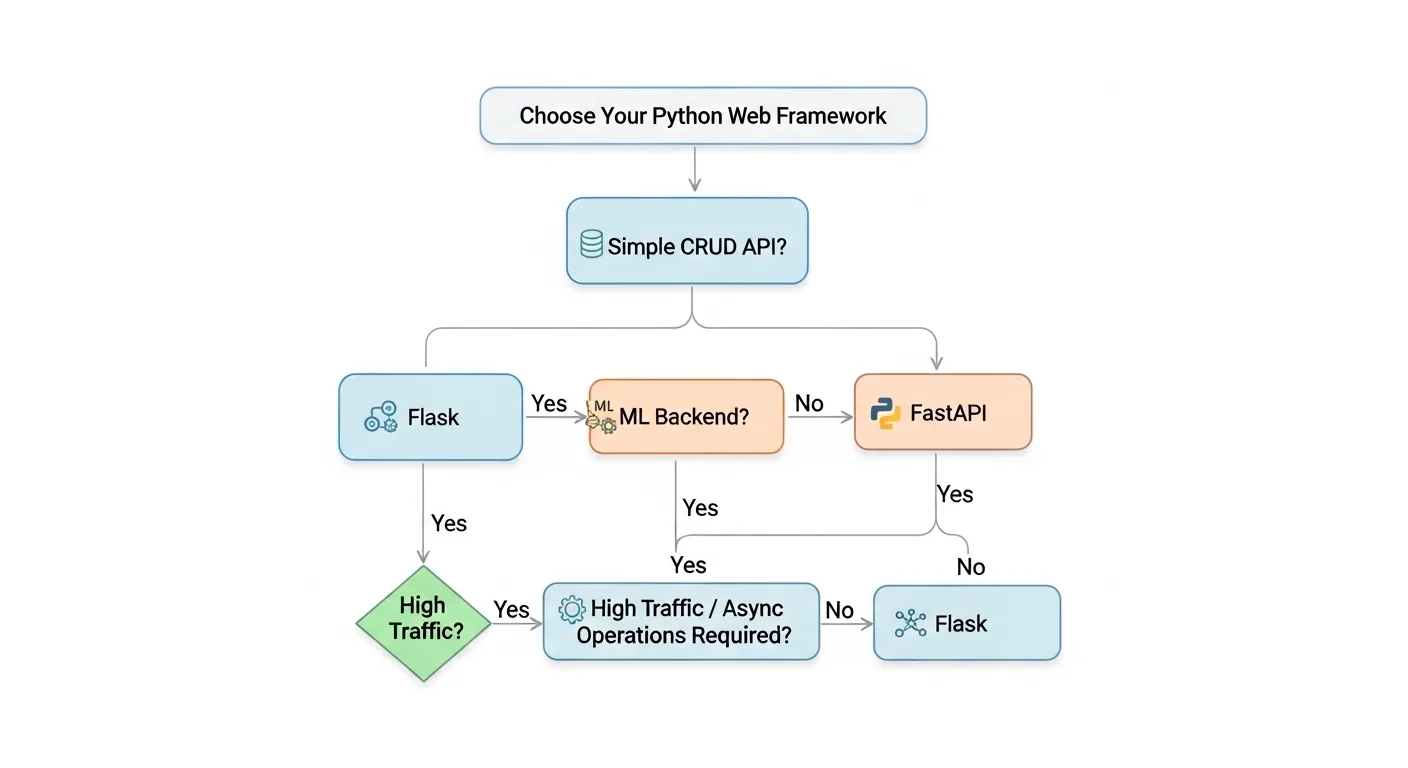
Time to get specific. What should you use in your next project?
✅ Simple CRUD App or MVP?
Winner: Flask
It’s lightweight, easy to deploy, and doesn’t ask you to think in Depends(). Perfect for:
-
Admin dashboards
-
Internal tools
-
“Let’s build this in a weekend” apps
🚀 High-performance API or Microservices?
Winner: FastAPI
It thrives under load and plays well in modern microservice ecosystems with:
-
Async DBs (e.g., Tortoise ORM)
-
Message brokers
-
Real-time APIs
🧠 ML/AI Model Deployment?
Winner: FastAPI
Serving LLMs? Hosting your own GPT? FastAPI is your friend:
-
Handles async inference
-
Great with background tasks
-
Built-in validation for input/output models
🧪 Prototyping or Teaching?
Winner: Flask
Still unbeatable for:
-
Bootcamps
-
University projects
-
Prototyping a proof of concept in an hour
🏢 Large Teams or API-First Startups?
Winner: FastAPI
When code quality, consistency, and documentation matter:
-
Auto docs reduce onboarding time
-
Type safety prevents runtime errors
-
Standardized dev workflow
It’s your new favorite team player.
8. Community, Ecosystem, and Longevity
Frameworks come and go like JavaScript trends, but both Flask and FastAPI have earned serious street cred in the Python world. Let’s talk community, tooling, and who’s playing the long game in 2025.
🌍 Community Size
-
Flask is a grizzled veteran with a massive user base. It’s been around for 15+ years, and nearly every Python dev has touched it.
-
FastAPI, meanwhile, is the shiny new thing that has grown fast—now with 70K+ GitHub stars and climbing.
🔧 Ecosystem Support
-
Flask boasts hundreds of plugins: from auth to forms to ORMs. If you can imagine it, there’s a Flask extension for it (or six).
-
FastAPI’s ecosystem is more focused: Pydantic, Starlette, Uvicorn, and async-first ORMs like SQLModel. Fewer tools, but more integrated.
💼 Real-World Adoption
Who’s using these frameworks in the wild?
-
Flask still powers legacy and internal apps at giants like Pinterest, Reddit, and LinkedIn.
-
FastAPI is now seen in production at Netflix, Microsoft, Hugging Face, and hundreds of fast-scaling startups.
FastAPI is also the go-to choice for AI/ML startups serving LLMs and real-time APIs.
🧠 Future-Proofing
FastAPI is clearly designed for modern Python: async, type-hinted, and OpenAPI-driven. It aligns with where Python development is going.
Flask? It’s still maintained and relevant, but it’s playing catch-up in async support.
If you’re building for 2025 and beyond, FastAPI is a safer bet. Flask is still valid—but it’s not leading the charge.
9. Migration Tips: Flask → FastAPI
Thinking of switching sides? It’s not as painful as you might think—unless you try to do it all in one day. (Don’t.)
🚦 When Migration Makes Sense
-
You need async performance
-
You want auto-validation or built-in docs
-
You’re moving to a microservices architecture
-
Your team wants to standardize around type hints
🧠 Mindset Shift: Sync → Async
The biggest hurdle is understanding async.
In Flask, you wrote:
def get_data():

result = db.query("SELECT * FROM stuff")

return result
In FastAPI, you’ll write:
async def get_data():

result = await db.query("SELECT * FROM stuff")

return result
It’s not rocket science, but it takes time to wrap your brain around async I/O, especially with database layers and third-party libs.
🛠️ Gradual Refactoring Strategy
-
Wrap Flask routes with a FastAPI-like structure in mind
-
Migrate one blueprint/module at a time
-
Use tools like
asgi-lifespan,flask-to-fastapiguides, and dual-run ASGI servers during transition -
Embrace Pydantic early—it’ll change your life (and make your code safer)
Start with stateless routes. Gradually move to async DBs and background tasks. Your future self will thank you.
10. Conclusion: Which Framework Should You Use in 2025?
Let’s recap this backend battle with a TL;DR chart.
| Use Case | Winner |
|---|---|
| Simple CRUD, Dashboards | Flask |
| Async, High Performance APIs | FastAPI |
| Machine Learning/LLM Serving | FastAPI |
| Prototyping & Teaching | Flask |
| Large Teams & Enterprise | FastAPI |
| Async I/O & Streaming | FastAPI |
| Legacy Support | Flask |
🔮 Final Thoughts
-
Flask is still solid, especially for MVPs and low-lift apps.
-
FastAPI is the future—async-native, type-safe, blazing fast, and designed for modern use cases.
But hey—you don’t have to pick one forever. Use Flask where it shines. Use FastAPI when performance, typing, or scale is key.
And if you’re feeling bold? Try building your next CRUD app in FastAPI and see what all the hype is about.
Because in 2025, the best framework isn’t the one with the most stars—it’s the one that helps you ship better software faster.
11. FAQ Section
Let’s knock out some common questions, SEO-style:
❓Is Flask going away in 2025?
Nope. Flask is still very much alive. It has active maintainers, regular updates, and a massive community. It’s just not the cutting edge anymore.
❓Can you use FastAPI like Flask for simple projects?
Yes, but… it might feel like overkill. FastAPI brings a lot of features you may not need for a tiny app. Still, for solo devs who love auto docs and type hints, it’s a great pick even for small stuff.
❓Is FastAPI suitable for production?
100%. FastAPI is production-tested at scale. Companies like Microsoft, Netflix, and Uber use it for APIs. Just make sure you understand async I/O and deploy with Uvicorn or Hypercorn properly.
❓Does Flask support async in 2025?
Yes, as of Flask 2.0, you can write async route handlers. But Flask’s core is still synchronous, so full async benefits (like handling thousands of concurrent requests) aren’t as easy to tap into.
❓Is FastAPI better than Django for APIs?
For REST APIs? Often, yes. FastAPI’s async-native design, automatic OpenAPI docs, and Pydantic validation give it the edge. Django is more full-stack and monolithic—it’s great for admin panels and ORMs, but heavier for APIs.
❓Can I run Flask on ASGI?
Yes—sort of. There are wrappers like asgiref or hypercorn, but Flask itself is not natively ASGI. You won’t get full async performance benefits without switching to something like FastAPI.
❓What’s the best framework for ML model serving?
FastAPI. It’s async-ready, handles large JSON payloads, supports streaming, and integrates beautifully with ML libraries. It’s the go-to choice for ML backends, LLM APIs, and inferencing services.
❓How hard is it to migrate from Flask to FastAPI?
It depends. Small apps are easier. Large Flask apps with blueprints, custom middleware, and lots of sync dependencies will need more love. But if you approach it module-by-module, it’s very doable.
❓Are there good alternatives to both?
Sure! Here are a few:
-
Django: Full-stack, batteries included
-
Tornado: Async-first, great for streaming
-
Sanic: Async-focused, similar to FastAPI
-
Starlette: The foundation of FastAPI—minimal but powerful
But honestly, Flask and FastAPI cover 95% of use cases in Python web development.
❓Which is better for beginners?
Flask is easier to start with. Less magic, fewer moving parts, and a very gentle learning curve. But if you’re already familiar with Python typing and async, FastAPI is surprisingly beginner-friendly too.
🎉 That’s a Wrap!
If you made it this far, you’re now officially qualified to settle all office debates with actual facts. Go forth, build cool things, and may your APIs be ever fast and your docs always up-to-date.
Need help choosing between Flask and FastAPI for your specific project? Drop me a message—I’ll try not to say “it depends” (but it probably does).
Learn beautiful Animations in powerpoint – https://www.youtube.com/playlist?list=PLqx6PmnTc2qjX0JdZb1VTemUgelA4QPB3
Learn Excel Skills – https://www.youtube.com/playlist?list=PLqx6PmnTc2qhlSadfnpS65ZUqV8nueAHU
Learn Microsoft Word Skills – https://www.youtube.com/playlist?list=PLqx6PmnTc2qib1EkGMqFtVs5aV_gayTHN