
Introduction: The Great Content Debate of 2025
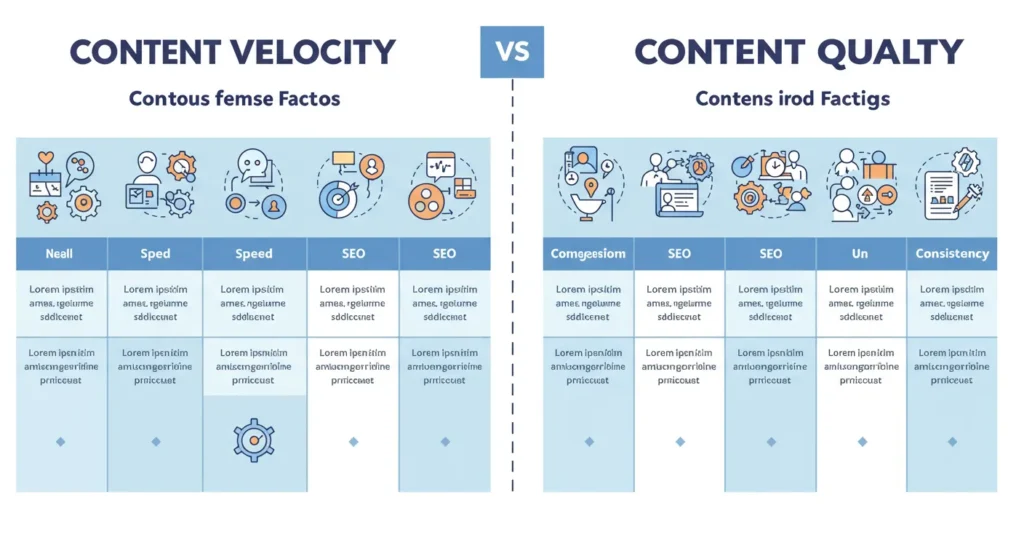
Let’s play a quick word game. I say “content marketing,” you say… “quality over quantity,” right? Or maybe it’s the other way around—“publish more, grow faster!” Either way, if you’re in the digital trenches in 2025, you’ve probably been caught in the tug-of-war between content velocity (how fast you publish) and content quality (how well it performs).
Here’s the kicker: the old “pick one” rule doesn’t hold up anymore.
The new truth? To scale content that actually drives ROI, we can’t simply pump out posts like a blog factory or spend months polishing the Mona Lisa of landing pages. You need a hybrid strategy—velocity meets quality—aligned with platform trends, audience behavior, and AI workflows.
In this in-depth guide, we’re diving into:
- What “content velocity” and “content quality” actually mean in 2025
- Why the balance between them matters more than ever
- The 7 powerful trends and rules to scale the right way this year
- Real-life examples and practical takeaways
- A framework you can adapt today
So grab your favorite productivity beverage (mine’s oat milk latte, thanks for asking), and let’s unpack this battle once and for all.

1. Trend: AI Has Made Content Cheaper—But Not Automatically Better
With tools like GPT-4.5, Jasper, Notion AI, and CoPilot doing the heavy lifting, content velocity has skyrocketed. You can now go from idea to article in 15 minutes. Magic, right?
Sort of.
The problem? So can your competitors. And if everyone’s publishing 100 blog posts a month with similar AI prompts, Google’s going to yawn. Your audience? Even more so.
Google’s Search Quality Rater Guidelines have doubled down on E-E-A-T (Experience, Expertise, Authoritativeness, and Trustworthiness). In 2025, AI-written content without human oversight is like fast food—cheap, quick, but ultimately forgettable.
✅ Takeaway:
Use AI to increase velocity, but humanize everything you publish. Add personal stories, custom data, analogies, and original insights to stand out.
💡 Pro Tip: Use ChatGPT for structure and outlines, but write intros, conclusions, and examples yourself. That’s where emotional impact happens.
2. Trend: Google’s Zero-Click Results Are Squeezing Mediocre Content
Thanks to SGE (Search Generative Experience), zero-click content is exploding. Users now get full answers in search results, meaning fewer people are clicking through to your site.
This hurts content that exists solely for traffic.
In contrast, high-quality, in-depth content that solves a deeper problem or offers a unique POV still attracts engagement and conversions.
✅ Takeaway:
Instead of chasing every keyword, focus on content that builds loyalty—email capture, storytelling, data visualizations, calculators, quizzes, or videos that keep users engaged on your property.

3. Trend: Content Decay is Real—But Updating Wins Over Rewriting
Velocity used to mean pumping out 20 blogs a month. Now, refreshing and repurposing outperform brand-new content in many cases.
2025’s top-performing teams treat content like assets: they audit quarterly, update for new data or trends, and optimize UX (user experience).
This helps maintain rankings, increase dwell time, and avoid Google’s “dead blog” penalty.
✅ Takeaway:
Set a “content refresh rate”—e.g., review your top 50 pages every 6 months. Use SEO tools (like Surfer SEO or Ahrefs) to prioritize by traffic loss.
Example: A SaaS company updated an old post titled “Best CRM Tools in 2023” to “Best CRM Tools for Small Teams in 2025” and regained 75% of its lost traffic.
4. Trend: Platforms Reward Quantity—But Only When It’s Consistent
Let’s be real: social platforms love consistency. TikTok, Threads, LinkedIn, YouTube Shorts—they all favor creators who show up daily or weekly.
The trick is to maintain a content cadence without burning out.
Velocity doesn’t mean chaos—it means creating repeatable systems:
- Weekly blog drops
- 3-reel-per-week workflows
- Email campaigns scheduled out 4 weeks in advance
✅ Takeaway:
Build a “content assembly line” with roles, templates, and automation. Quality can be baked in without sacrificing speed.
Pro tip: Use content pillars + batching to stay ahead. One long-form blog → 5 LinkedIn posts, 2 Reels, 1 email.
5. Trend: Thought Leadership Now Outranks Generic SEO Content
Everyone’s writing “How to Use Excel.” Fewer are writing, “How I Automated My Weekly Reporting in Excel and Saved 10 Hours a Month (With Screenshots).”
Audiences crave authenticity and specificity—especially in B2B and niche markets.
Brands that win in 2025 are those that put faces behind the content. Think founder blogs, expert videos, data-backed case studies, and bold opinions.
✅ Takeaway:
If you want to scale reach and trust, include human voices in your content strategy. Encourage team members to create or co-sign thought pieces.
🎯 Try this: Turn an internal Slack convo into a blog post. It’s real, raw, and resonates.
6. Trend: Video is the New Long-Form—But It Requires Quality Control
Short-form is still dominant, but longer videos (3–10 minutes) are now driving conversions and building authority.
In 2025, even text-heavy teams are adding:
- Tutorials
- Product walkthroughs
- Behind-the-scenes content
- Screen recordings
But here’s the catch: bad video production kills trust faster than a typo in your headline.
✅ Takeaway:
Outsource editing or use templates (CapCut, Descript, Canva video) to ensure visual consistency even with high velocity.
Tip: Don’t start from scratch. Repurpose blog posts into video scripts. You already have the value—just change the medium.

7. Trend: Content Without Distribution Is Just Digital Dust
Publishing content is no longer the finish line—it’s the starting pistol. Without a distribution strategy, even your highest-quality content can disappear into the void.
In 2025, the best teams build “after publish” playbooks:
- SEO optimization
- Email newsletter inclusion
- Social snippet scheduling
- Influencer or employee amplification
- Paid promo for top content
✅ Takeaway:
Spend 30% of your content time on creation, 70% on distribution. That’s where the growth lives.
Framework: 1 piece of pillar content → 10 content derivatives → 30 days of distribution.
Bonus: 7 Rules to Win the Velocity vs. Quality Game in 2025
Let’s bring it home. Here are the 7 non-negotiable rules of modern content strategy:
- Start with strategy, not software – AI helps, but strategy scales.
- Humanize AI content – Use your voice, your stories, your data.
- Refresh > Rewrite – Update top content before creating new.
- Batch for velocity – Use themes, templates, and repurposing.
- Create for humans, optimize for search – Never flip that order.
- Quality over time – Not just polish, but purpose and payoff.
- Distribute like you mean it – Content without promotion is invisible.
Final Thoughts: So, What Actually Scales?
Here’s the honest truth: neither content velocity nor content quality works in isolation.
It’s not about more or better—it’s about strategic, scalable, and sustainable content that serves your business and your audience.
When you combine smart systems with standout value, you can publish more and better.
The brands winning in 2025? They’re not picking sides. They’re building bridges.

Let’s Keep the Conversation Going
Now it’s your turn:
- Have you struggled with the quality vs. quantity dilemma?
- What’s working for your content strategy in 2025?
- Are you team velocity, team quality… or team both?
👇 Drop a comment, share this with your fellow marketers, or send me your hot take on LinkedIn. Let’s grow smarter—together.
🤔 Frequently Asked Questions (FAQs)
Q1: What is content velocity in digital marketing?
Content velocity refers to how quickly and how often you publish content—blogs, videos, emails, social posts, etc. It’s often measured by how many assets go live per week or month. The idea is that more content = more visibility, but only if the quality and strategy are there too.
📌 Think of it as “how fast your content engine runs.”
Q2: What is content quality and how is it measured?
Content quality refers to how effective your content is at meeting its goal—whether that’s ranking on Google, getting shared, generating leads, or educating an audience. It’s typically measured through:
- Engagement (time on page, comments, shares)
- Conversion rates
- Bounce rate
- SEO performance
- Reader feedback
💡 Pro tip: Content quality isn’t about flowery language—it’s about clarity, value, and actionability.
Q3: Can you really have both high velocity and high quality?
Yes—but only with the right systems and workflows. The secret lies in:
- Using AI tools for drafting, not for full automation
- Repurposing long-form content into multiple formats
- Delegating tasks (editing, design, SEO, distribution)
- Creating reusable templates and guidelines for consistency
🚀 Scaling isn’t about working harder—it’s about working smarter.
Q4: Is high-quality content still worth it with AI and zero-click search results?
Absolutely. In fact, quality matters more than ever. AI-generated snippets and search summaries may answer quick questions, but they don’t build trust, convert customers, or create brand advocates.
📣 The content that wins in 2025 offers more than answers—it delivers insights, stories, and solutions.
Q5: How do I balance creating new content and updating old content?
A good rule of thumb: 60% refresh, 40% new. Here’s a simple approach:
- Identify top performers with declining traffic
- Update stats, screenshots, and examples
- Optimize meta tags and structure
- Add internal links to newer content
🛠 Tools like Ahrefs, Google Search Console, and Screaming Frog can help automate your content audit process.
Q6: What platforms favor content velocity the most in 2025?
- TikTok – Favors frequent posting and trend-hopping
- Threads & X (Twitter) – Fast-paced conversational content thrives
- LinkedIn – Consistent posting leads to higher visibility
- YouTube Shorts – Frequency builds momentum and recommendations
📱 Velocity doesn’t mean low effort—it means showing up with value consistently.
Q7: How can small teams scale content without sacrificing quality?
Here are five tactics that work in 2025:
- Use AI for outlines, not final drafts
- Build a content calendar around evergreen topics
- Repurpose one asset into multiple formats
- Invest in freelance or agency support (for editing/design)
- Use project management tools like Notion, ClickUp, or Trello
🔁 Quality + consistency = compounding results, even for small teams.
Q8: What metrics should I use to evaluate if my content strategy is scaling?
Look beyond vanity metrics. Key indicators of scalable content include:
- Organic traffic growth (SEO)
- Leads or conversions from content
- Subscriber growth (email or YouTube)
- Social shares and saves
- Content repurpose potential (i.e., evergreen structure)
📈 A scalable strategy produces content that keeps working long after you publish it.