
Introduction: Is the C Throne Under Siege?
Ah, C — the granddaddy of systems programming. Born in the ‘70s, forged in Bell Labs, the language that basically taught computers how to walk, talk, and crash gloriously. It’s been the backbone of Unix, the brains behind operating systems, and the brawn inside embedded devices. If you’ve ever written malloc without breaking into a cold sweat, congrats — you’re a real one.
Table of Contents
ToggleBut here’s the million-dollar question for every seasoned C programmer today:
“Is it finally time to upgrade your systems programming skills and learn Rust?”
Rust isn’t just another shiny new tool that promises everything and delivers a headache. It’s a serious, memory-safe, compile-time-enforcing, zero-cost-abstraction monster of a language. It was built to address the very pain points that C developers have been wrestling with for decades — buffer overflows, memory leaks, null pointer dereferences, and the eternal war against undefined behavior.
Originally dreamed up by Mozilla and released as stable in 2015, Rust has now earned its stripes. Major players like Microsoft, Meta, Amazon, and the Linux kernel devs are embracing it — not just for greenfield projects but as a replacement for C in high-stakes systems.
So, should you — a battle-hardened C dev — actually learn this “fearless” language?
In this guide, we’ll break it down across syntax, memory safety, performance, tooling, and real-world adoption. Whether you’re building embedded systems, contributing to open-source kernels, or just want to stop shipping segfaults, we’ve got answers.
Let’s compare C vs Rust like grownups: with benchmarks, real-world use cases, and maybe a little side-eye at malloc.
1. A Brief History of C and the Rise of Rust
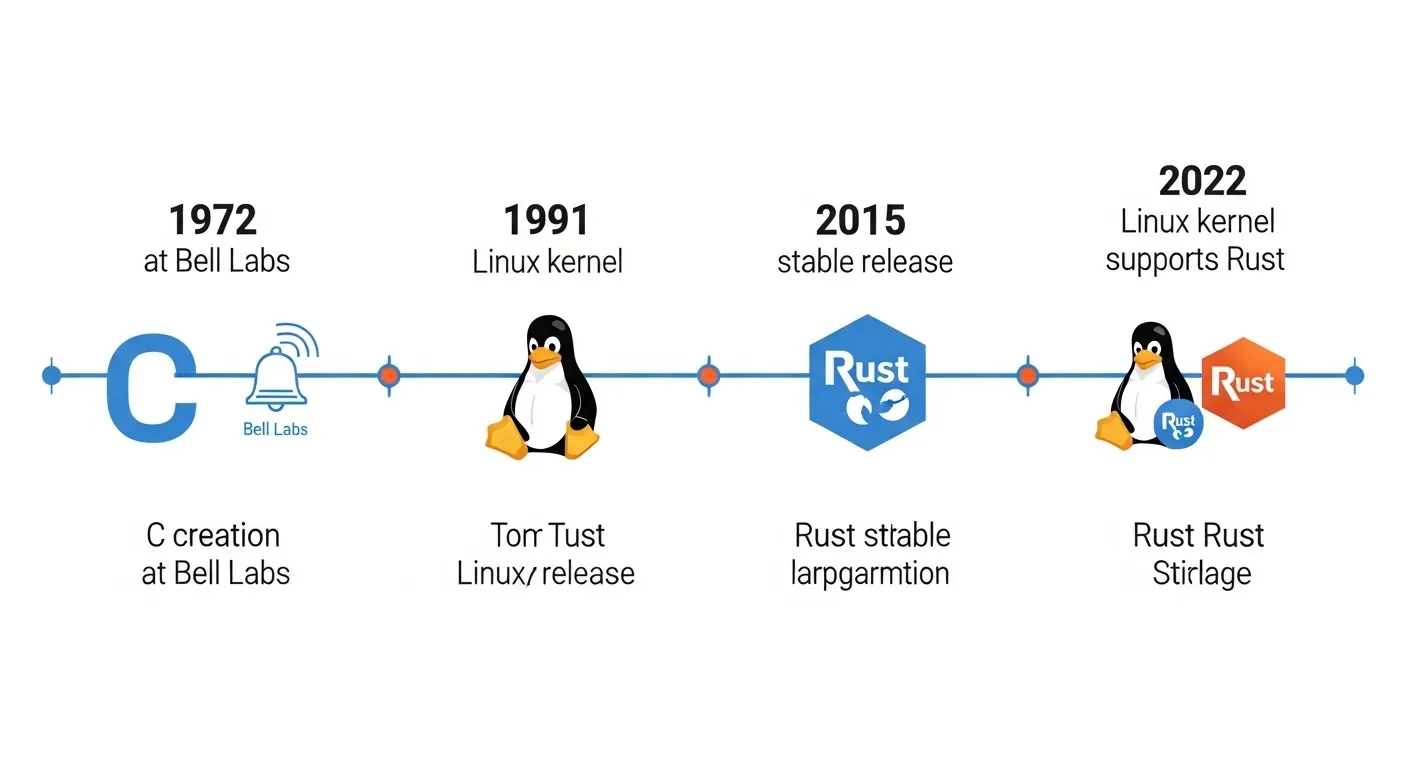
C was born in 1972 at Bell Labs, designed by Dennis Ritchie as a language to develop Unix. Its elegance came from doing more with less — powerful operators, direct memory access, and barely-there abstractions. It spread like wildfire, powering Unix, Linux, Windows internals, device drivers, firmware, and embedded systems. And let’s be real — half the internet still runs on C code someone wrote in the ‘90s.
But power has its price. C gives you the keys to the memory kingdom… and then lets you drive it into a segmentation fault. Buffer overflows, dangling pointers, memory leaks — these aren’t bugs, they’re rites of passage.
Enter Rust. Conceived at Mozilla in 2010 and officially stabilized in 2015, Rust wasn’t built to “replace C” as a slogan — it was born out of necessity. Mozilla’s browser engine, Servo, needed performance and safety. The goal: memory safety without garbage collection.
Rust introduced a paradigm shift — ownership, borrowing, lifetimes — ensuring you can’t compile bad memory access. It’s like having a compiler that’s also your overprotective (but brilliant) co-pilot.
Why did it take off?
-
Memory safety matters now more than ever. From Spectre to Heartbleed, memory vulnerabilities in C/C++ have cost billions.
-
Concurrency is the future. But C’s thread safety is basically “Don’t screw it up.”
-
Security is non-negotiable. In Rust, safety is baked into the language design.
And companies noticed. Microsoft is rewriting parts of Windows in Rust. Amazon built Firecracker (a lightweight virtualization tool) in Rust. Meta uses Rust for critical backend systems. And — plot twist — Linux kernel contributors are now accepting Rust code. That’s right. Linus blinked.
Rust didn’t rise just because it’s new. It rose because we’ve outgrown some of C’s pain points.
2. Syntax & Language Design: Familiar Yet Different
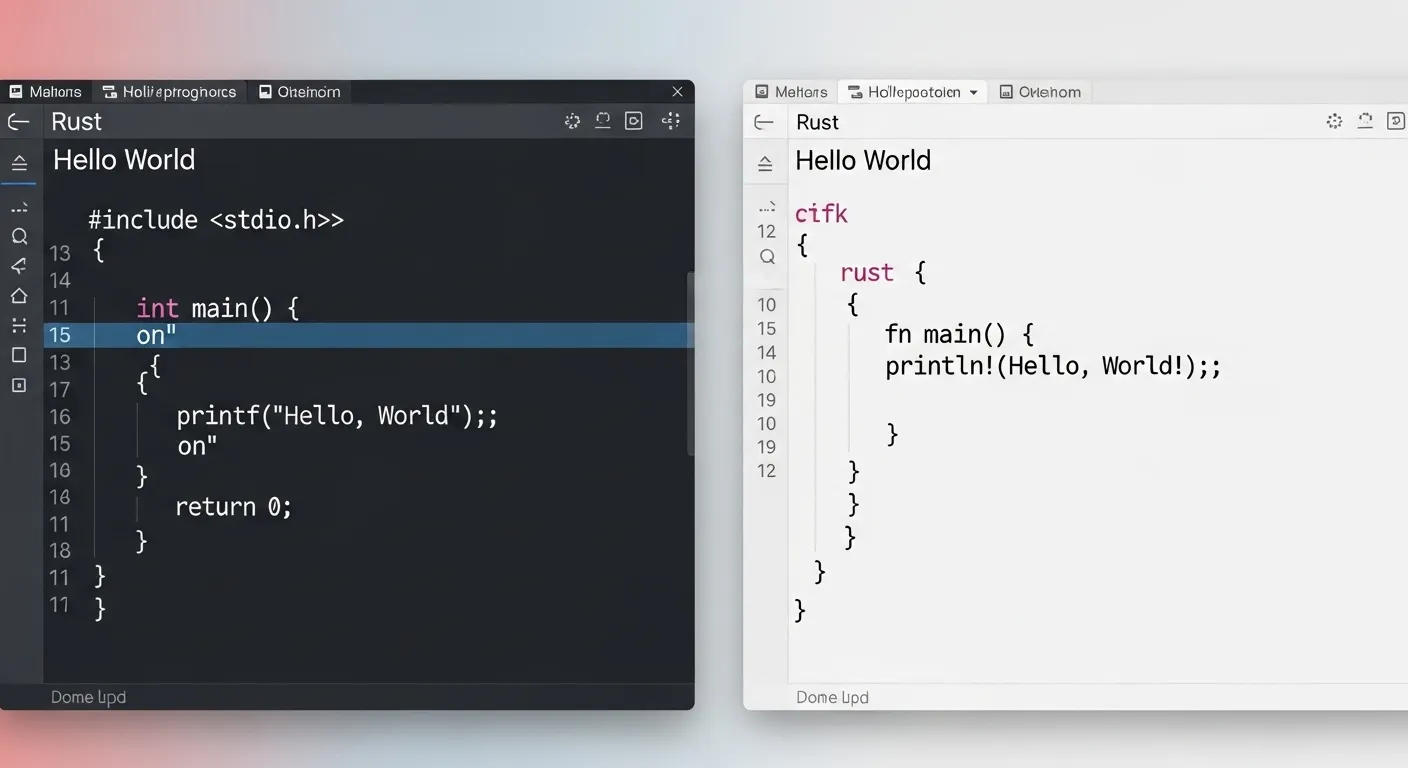
If you’re fluent in C, Rust will feel… strange at first, but not alien. Let’s peek under the hood.
Hello World
// C

#include <stdio.h>

int main() {

printf("Hello, world!\n");

return 0;

}
// Rust

fn main() {

println!("Hello, world!");

}
Okay, that’s easy. But let’s go deeper.
Pointers & Memory
int *p = malloc(sizeof(int));

*p = 42;

free(p);
let b = Box::new(42); // Memory managed by ownership system
In C, you manage memory. In Rust, the compiler does it — and won’t let you screw it up.
Structs
struct Point {

int x;

int y;

};
struct Point {

x: i32,

y: i32,

}
So far, so familiar — but Rust adds pattern matching, enums with data, and no nulls.
enum Direction {

North,

East,

South,

West,

}
No NULL? Yep — Rust uses Option<T>. You can’t accidentally dereference a null pointer because they don’t exist.
Ownership & Borrowing
This is where things change:
fn print_num(num: &i32) {

println!("{}", num);

}
Rust forces you to think about who owns what. It’s annoying at first — like being told you can’t drive without a seatbelt — but it prevents 90% of memory bugs you’d hit in C.
The transition pain? Real, especially for C veterans. But once you “get it,” it clicks hard.
3. Memory Safety: Manual vs Compile-Time Guarantees
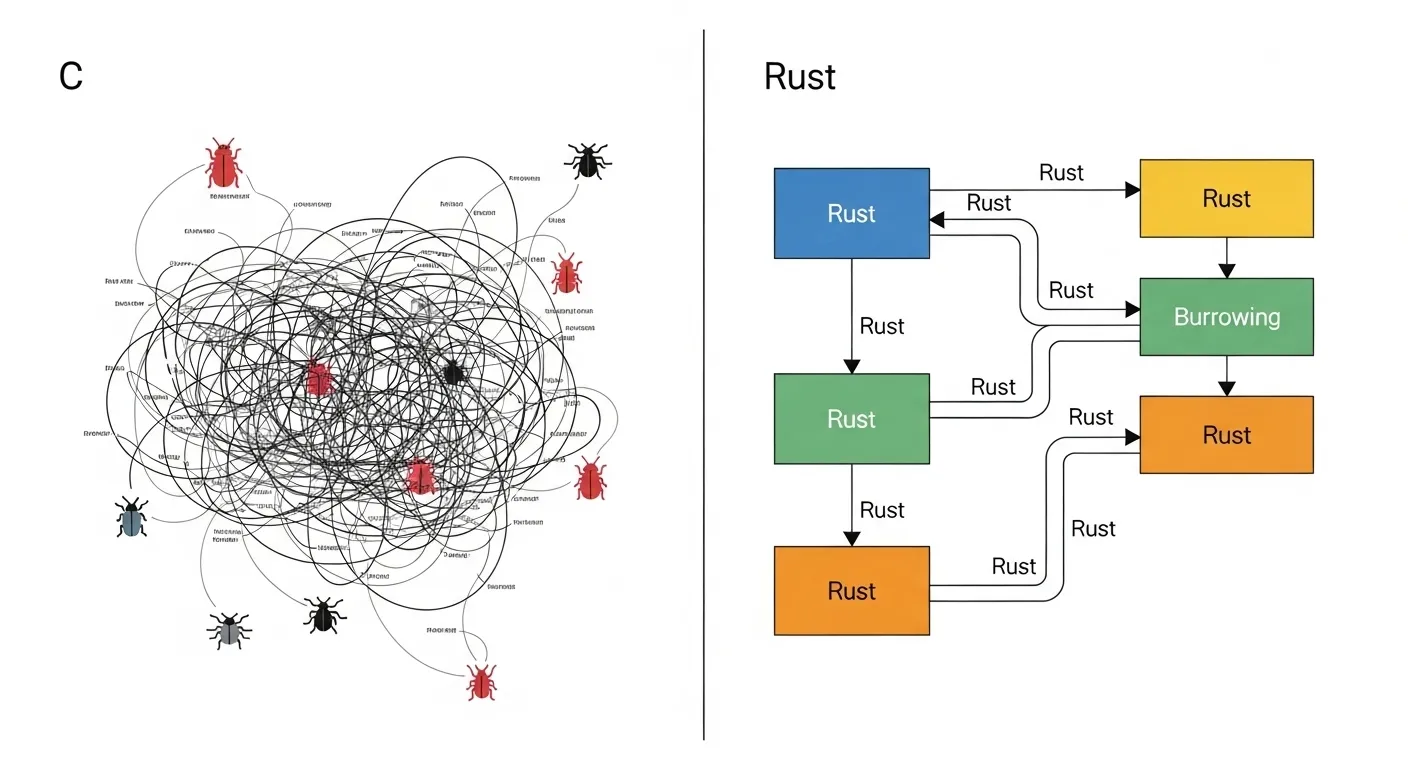
C gives you a loaded gun and says, “Try not to shoot yourself.”
Use-after-free, buffer overflows, memory leaks, wild pointers — if you’ve written C, you’ve wrestled all of them.
Rust’s answer? Don’t even let the bad code compile.
In C:
char *buf = malloc(10);

strcpy(buf, "this is way too long"); // Oops: buffer overflow

free(buf);
In Rust:
let mut buf = String::with_capacity(10);

buf.push_str("this is way too long"); // Panic, not corruption
Rust’s ownership and lifetimes enforce:
-
No double frees
-
No use-after-free
-
No data races
-
No dangling pointers
It’s like valgrind is now built into your compiler.
But wait — there’s unsafe in Rust!
Yes, Rust has an unsafe keyword. But the brilliance? Unsafe code is opt-in and contained. You can write low-level C-style code if needed — but the rest of your program stays safe.
Compile-Time Checks
Rust stops you before the program runs. In C, the fun starts after your code compiles and explodes at runtime.
Here’s a classic C error that Rust just won’t allow:
char *str = malloc(10);

free(str);

strcpy(str, "boom!"); // Use-after-free
Rust would scream:
let s = String::from("hello");

drop(s);

println!("{}", s); // ERROR: value borrowed after move
No segfault. Just a grumpy compiler.
Bottom line? Rust makes whole classes of C bugs impossible. And that’s a game-changer for safety-critical systems.
4. Performance: Is Rust as Fast as C?

Let’s talk about the elephant in the room: performance.
C has long been the Usain Bolt of systems programming — lean, mean, and ruthlessly fast. So how does Rust stack up?
Short answer: Rust is just as fast, and sometimes even faster.
Long answer: Let’s dive into why.
Rust is built on LLVM, just like Clang, and supports zero-cost abstractions. That means features like iterators, closures, and traits don’t cost you anything at runtime if the compiler can optimize them away. With Rust, you write expressive, high-level code — and it compiles down to blazing-fast machine code.
Real-World Matchups
-
ripgrep vs grep: Ripgrep (written in Rust) consistently beats grep in recursive searches. Faster and safer.
-
Firecracker: Amazon’s microVM engine — pure Rust. Designed for ultra-low-latency environments.
-
Embedded Rust: Microcontrollers like STM32 and RP2040 run Rust just fine. And Rust even beats C on some bare-metal tasks because you don’t have to add runtime checks manually — Rust already has your back at compile time.
When C Still Wins
-
Binary size: C is often smaller, especially in tiny microcontroller projects where every byte counts.
-
Startup time: C sometimes edges out Rust in ultra-fast cold starts (though we’re talking microseconds).
-
Control over ABI: In some low-level scenarios, C still rules when you need raw, exact control.
But in the vast majority of real-world systems?
Rust equals C in speed — and crushes it in safety.
5. Concurrency: The Safe Parallelism Revolution
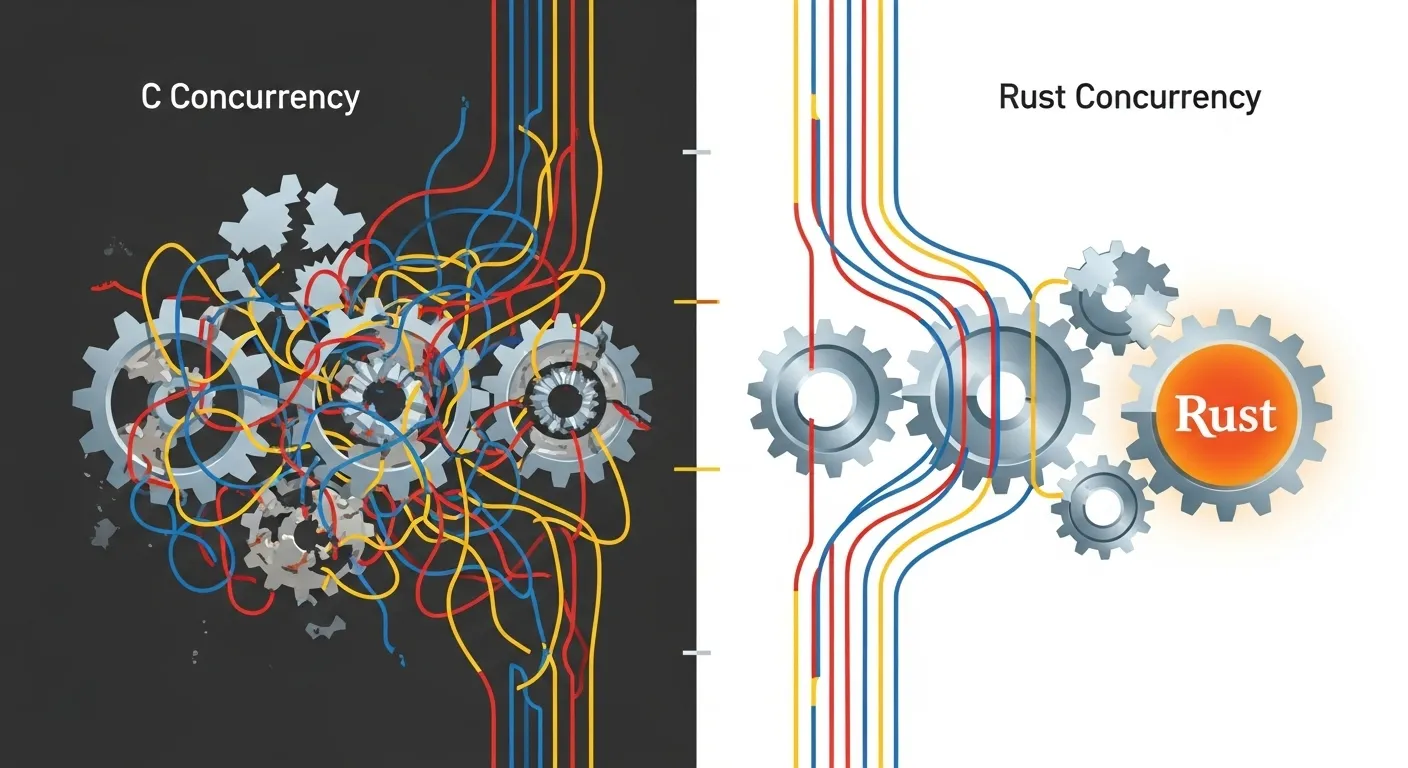
Concurrency in C is like juggling knives — blindfolded — while riding a unicycle through a minefield.
You’ve got threads, mutexes, locks, semaphores… and if you forget anything, you get a race condition, a deadlock, or some beautiful undefined behavior.
Rust saw that chaos and said, “Hold my beer.”
Rust’s Secret Sauce: Ownership + Traits
In Rust, concurrency isn’t just an afterthought — it’s built into the type system. You get two key traits:
-
Send: Type can be transferred between threads -
Sync: Type can be safely shared between threads
If a type isn’t safe to share — Rust won’t compile your code.
use std::thread;
let handle = thread::spawn(|| {
println!(“Hello from another thread!”);
});
handle.join().unwrap();
In C, you’d need pthread_create, error handling, and hope.
Fearless Concurrency
Rust eliminates data races at compile time. That’s not marketing fluff — that’s enforced by the borrow checker.
And if you want async?
-
Rust gives you tokio or async-std
-
Futures and async/await are zero-cost
-
You can write highly concurrent, non-blocking code with safety
In contrast, C’s async story is… callback hell, custom schedulers, or POSIX threads with duct tape.
Concurrency in Rust is like driving a race car with airbags and autopilot. You still have power — but it’s wrapped in seatbelts.
6. Tooling, Ecosystem & Developer Experience
Let’s face it: building in C sometimes feels like assembling IKEA furniture with a butter knife. Yes, you can do it — but it ain’t pretty.
Rust? It gives you the full toolbox out of the gate.
In the C World:
-
Compilers: gcc, clang — fast but fragmented
-
Debugging: gdb — powerful but old-school
-
Build systems: Make, CMake, autotools — confusing even for veterans
-
Package management: Um… manually hunt down
.tar.gzfiles?
In Rust:
-
cargo: One tool to build, run, test, format, benchmark, and manage dependencies
-
rustc: Compiler with clear error messages and helpful suggestions
-
clippy: Linter that nags you like a loving parent
-
rustfmt: Automatic code formatting (goodbye, tabs vs spaces debate)
-
docs.rs: Auto-generated docs for every crate
-
crates.io: Like npm, but for Rust — a central, secure package registry
cargo new my_project

cargo run

cargo test

cargo fmt
That’s your daily workflow. Simple, modern, delightful.
IDE Support
-
VSCode: With the rust-analyzer extension? A dream.
-
CLion: Full Rust plugin support.
-
IntelliJ, Vim, Emacs: All play nice.
Bottom line? Rust tooling is modern, integrated, and doesn’t make you cry. That alone boosts productivity — especially compared to the duct-taped experience of C.
7. Real-World Use Cases: Who’s Using Rust?

Rust is no longer the “cool kid” language — it’s in the real-world trenches now.
Embedded Systems
You might think Rust is too heavy for microcontrollers, but think again:
-
No_std lets Rust run without the standard library
-
Frameworks like RTIC, embedded-hal, and esp-rs make embedded Rust real
-
Projects like TockOS and firmware for RP2040 chips use Rust successfully
Operating Systems
-
Redox OS: A Unix-like OS written in Rust — even the kernel!
-
Linux Kernel: Rust has been accepted for kernel modules since 2022. Linus says it’s the way forward — carefully, but confidently.
Security-Sensitive Software
-
Dropbox: Uses Rust for file sync and networking
-
Amazon: Firecracker microVMs are built in Rust
-
Cloudflare: Rewrote high-performance networking code in Rust to eliminate memory issues
Games, WASM, and CLI Tools
-
Game engines like Bevy are built in Rust
-
WebAssembly loves Rust: compile directly to
.wasmwithwasm-pack -
CLI tools like ripgrep, bat, fd, and exa prove Rust is fast, modern, and better than their C counterparts
When C Still Shines
-
Legacy systems that can’t be touched
-
Real-time OS where every byte counts
-
When hardware quirks require ultra-fine control
But if you’re starting something new — and especially if safety matters — Rust might be the smarter choice.
8. Learning Curve: The Cost of Switching
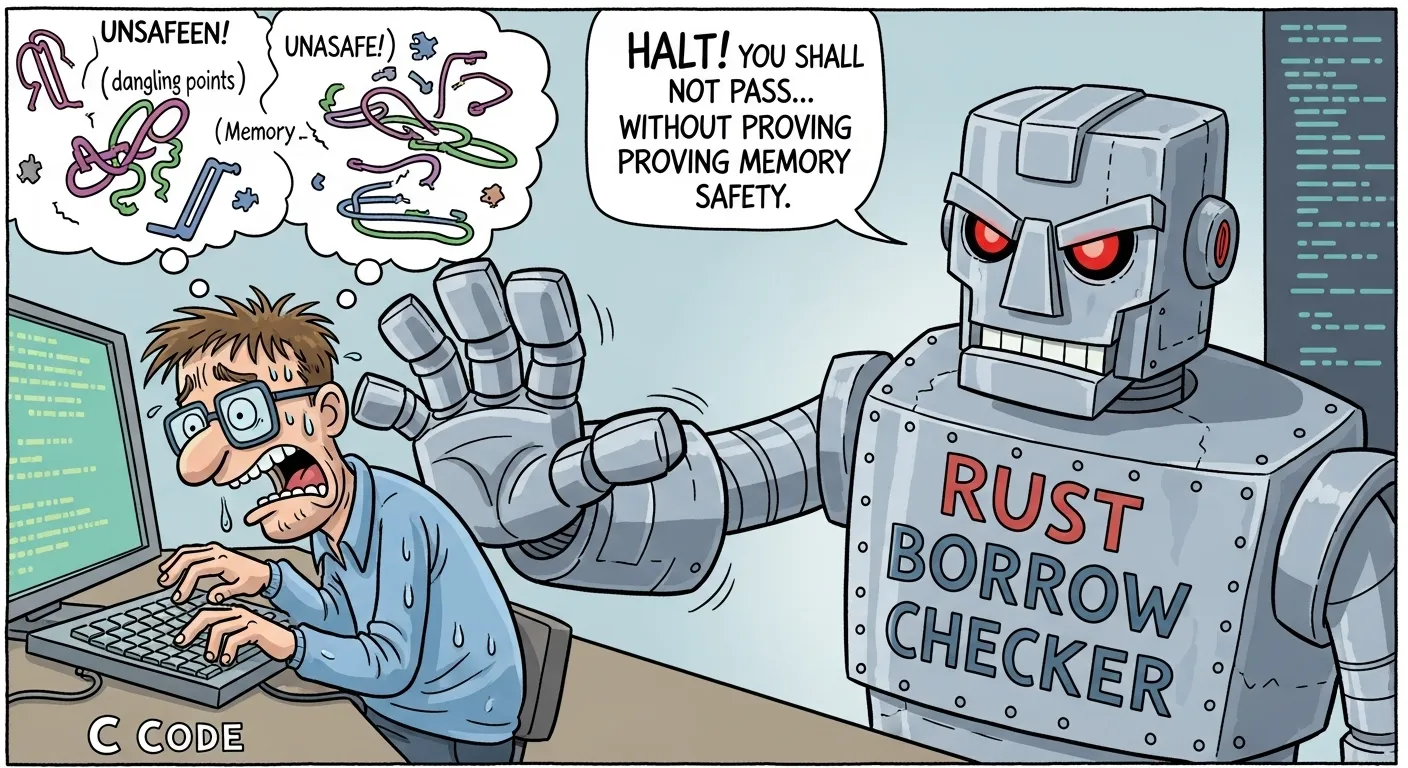
Let’s rip the Band-Aid off: Rust is harder to learn than C — at first.
C is low-level, but it’s also brutally straightforward. You say “malloc,” it gives you memory. You say “free,” it salutes and obliterates your pointer. Rust, on the other hand, talks back.
Rust’s ownership model, lifetimes, and borrowing rules take time to “click.” You’ll fight the compiler. You’ll scream at it. It will scream back — but always with love and documentation.
What trips C devs up?
-
You can’t have two mutable references to the same data at once.
-
You can’t “just” clone everything like in C++.
-
You don’t malloc/free — you own values, and when ownership ends, memory is freed.
It feels like your freedom is being taken away — but it’s really being safeguarded.
How long to get productive?
-
A few weeks to write safe Rust if you’re actively coding
-
A few months to feel comfortable with ownership
-
A year or so to feel like a Rust ninja
Friendly Learning Tools
-
📘 The Rust Book (aka The Bible) – free, online, and surprisingly funny
-
🧠 Rustlings – tiny exercises that help the concepts sink in
-
🔧 Crate cheat sheets and C-to-Rust migration guides
And guess what? Once you “get” Rust, you start noticing how many bugs you used to write in C. The compiler becomes your best friend, not your enemy.
9. Migration Strategies: Should You Rewrite Everything?
Nope. Don’t do it. Never rewrite a working C codebase just because Rust is shiny. That’s how developers go broke and teams cry.
Enter FFI (Foreign Function Interface)
Rust and C can play together beautifully. You can call C libraries from Rust and even call Rust from C.
From Rust to C:
#[no_mangle]

pub extern "C" fn add(x: i32, y: i32) -> i32 {

x + y

}
Compile this, link with your C code — boom.
From C to Rust:
extern "C" {

fn c_function(arg: i32);

}
Use bindgen to generate Rust interfaces from C headers. It’s magical.
Real Migration Strategy
-
Identify hot, risky C modules — memory-sensitive or concurrent areas
-
Rewrite those in Rust — get the safety where it matters
-
Interface via FFI — keep the rest in C
-
Gradually replace more as needed
This hybrid approach is exactly what Microsoft, Amazon, and the Linux kernel are doing.
No need to nuke your C code. Just inject Rust where it makes things safer, faster, or more maintainable.
10. Future Outlook: Will Rust Replace C?
Let’s be honest — C isn’t going anywhere anytime soon.
It’s too entrenched. Billions of lines of C power the world’s operating systems, routers, medical devices, and firmware. And rewriting all that? Not gonna happen this decade.
But here’s the twist: Rust doesn’t need to “replace” C to win.
It just needs to keep carving out territory where:
-
Memory safety matters
-
Security is a priority
-
New systems are being built
And that’s exactly what it’s doing.
The Tipping Point?
-
Linux kernel support for Rust: Huge credibility
-
Microsoft Windows internals: Using Rust now
-
Embedded ecosystems: Rust support growing rapidly
It’s not about domination — it’s about coexistence. Like cats and dogs. They don’t have to like each other. But they can live in the same house.
C will always be there for raw speed, microcontroller hacks, and legacy hardware. But Rust? It’s becoming the default for greenfield systems where correctness matters.
Conclusion: Should You Upgrade Your Systems Programming Skills?
So here we are. One language forged in the fires of Bell Labs. Another rising from the ashes of memory bugs and race conditions.
C is still a beast — powerful, portable, and predictably dangerous. If you like living on the edge and squeezing every byte, it still gets the job done.
Rust is the new kid with a seatbelt, a helmet, and a compiler that doesn’t let you do dumb things — even if you beg it to. It may frustrate you at first, but you’ll write fewer bugs, enjoy better tooling, and sleep better at night.
Here’s the deal:
-
You don’t have to quit C.
-
You don’t have to rewrite everything.
-
But learning Rust could be the smartest upgrade to your career since you figured out
gdb.
Memory safety, modern tooling, fearless concurrency — Rust brings real value. And it’s not hype — it’s happening now.
So go ahead. Download rustup. Do a cargo new. Fight the borrow checker like your life depends on it.
Because someday soon, it just might.
Bonus FAQ: Real Questions, Brutally Honest Answers
Is Rust harder to learn than C?
Yes — and no. C teaches you how to think like the machine. Rust teaches you how to argue with the machine until you’re both right.
C’s learning curve is shallow but full of hidden traps. Rust’s curve is steep — but once you reach the top, it’s smooth sailing with fewer runtime errors.
If you’ve mastered C, you’ll pick up Rust faster than a JavaScript dev would (bless their hearts).
Can Rust really replace C in embedded systems?
In many cases, yes. With #![no_std], Rust can run on bare metal just like C. It’s already running on ARM Cortex-M chips, ESP32s, and more.
But there are trade-offs:
-
Rust’s binaries can be a bit bigger (though this is improving)
-
Tooling for niche chips isn’t always as mature
-
Some hardware quirks still require hand-tuned C/Assembly
Still, for new embedded projects where safety is crucial, Rust is absolutely viable.
How does Rust compare to C in Linux development?
Rust is now officially part of the Linux kernel! Developers are adding drivers in Rust because:
-
It prevents common bugs (null dereferences, use-after-free)
-
It simplifies thread-safe code
-
It doesn’t require a garbage collector
C is still the dominant force in kernel space — but Rust is becoming the new safe bet for new components.
Is Rust slower than C in real-world applications?
In general, no.
Rust uses zero-cost abstractions and LLVM optimizations. In many cases, Rust matches or outperforms C — especially when you’re not writing hand-optimized assembly.
If you really need that last microsecond, you can always use unsafe and fine-tune things. But most of the time, Rust’s safety doesn’t cost performance.
Do I need to abandon C entirely to adopt Rust?
No way. In fact, smart developers keep both in their toolbox.
You can:
-
Use C for hardware-level stuff
-
Use Rust for safety-critical modules
-
Combine them with FFI
You don’t have to pick a side. You can be multilingual and pragmatic.
What are the limitations of Rust compared to C?
Let’s be real. Rust isn’t perfect:
-
Compilation is slower
-
Binaries can be bigger
-
Learning curve is real
-
You don’t always get the same level of ABI control
But for many use cases, the trade-offs are worth it.
Rust isn’t trying to be C. It’s trying to be better than C where it counts — memory safety, concurrency, tooling, and long-term maintainability.
Final word: You already know how to survive in C.
Rust helps you thrive — with fewer bugs, better tooling, and a brighter future.
So go ahead, upgrade your systems programming brain. It’s time.
Learn beautiful Animations in powerpoint – https://www.youtube.com/playlist?list=PLqx6PmnTc2qjX0JdZb1VTemUgelA4QPB3
Learn Excel Skills – https://www.youtube.com/playlist?list=PLqx6PmnTc2qhlSadfnpS65ZUqV8nueAHU
Learn Microsoft Word Skills – https://www.youtube.com/playlist?list=PLqx6PmnTc2qib1EkGMqFtVs5aV_gayTHN