
C Programming Interview Questions in 2025 (With Expert-Level Answers)
Looking for the ultimate C programming interview questions 2025 guide? You’ve landed in the right debugger window. This isn’t just another “list of C interview questions” scraped from the depths of GeeksforGeeks — it’s a battle-tested prep resource built by someone who’s been grilled in embedded C interviews, cornered in systems programming whiteboards, and had to explain volatile before their second coffee. Whether you’re fresh out of university, a mid-level dev eyeing systems work, or a senior embedded engineer brushing up on modern C (yes, including shiny new C23 features), this guide will walk you through fundamentals, tricky pointer puzzles, concurrency quirks, and more — all with expert-level answers and tips to ace the actual interview.
Quick TL;DR
If you’re hunting for C programming interview questions 2025 that actually prepare you for the real thing — here’s your all-in-one cheat code.
✅ 80+ questions from basics to expert-level C23 topics
✅ Embedded & systems programming scenarios
✅ Mock interview plan + downloadable cheatsheet
Whether you’ve got 2 weeks or 3 months to prep, this guide covers fundamentals, modern standards, and the “trick questions” interviewers love to spring.
Why This Guide Matters in 2025
If you thought C was a “done and dusted” language, frozen sometime in the ‘80s next to mullets and floppy disks — think again.
In 2025, C is still the go-to language for systems programming, embedded firmware, OS kernels, and high-performance tools where every byte counts. And interviewers? They know it.
Whether you’re targeting a low-latency trading system gig in a glass tower or writing firmware for a toaster that also tweets, companies expect you to handle:
-
Pointers like a surgeon wields a scalpel
-
Memory management without causing mysterious midnight segfaults
-
Concurrency without accidentally summoning race conditions from the void
-
And now… modern C standards knowledge — yes, that includes C23.
C23 isn’t just a “boring committee update” — it’s the first major refresh in over a decade, and interviewers love slipping in questions to see if you’ve done your homework. Expect questions about:
-
u8character literals — because UTF-8 matters now more than ever -
Bit-precise integers (
_BitInt) — for when “32 bits” is 30 too many -
Decimal floating types — financial apps, rejoice
-
Attributes for better compiler hints
-
memset_explicit— secure memory clearing for sensitive data -
char8_t— finally, a dedicated UTF-8 char type
Interviewers in embedded C roles will still grill you on startup code, linker scripts, and volatile memory-mapped I/O. Meanwhile, systems programming candidates might get atomic ops, memory barriers, and POSIX thread scenarios thrown at them before they can blink.
This guide is built to handle all of that — blending classic questions, modern twists, and expert-level answers so you can walk into 2025 interviews knowing more than the person across the table (and maybe their boss too).
How to Use This Article
Think of this guide as your C programming interview GPS for 2025 — it’ll get you from “uhh… what’s a storage class again?” to confidently explaining C23 bit-precise integers without breaking a sweat.
Here’s your roadmap:
-
Beginners: Start with Fundamentals and Pointers & Memory.
-
Mid-level devs: Add Data Structures, Concurrency, and Debugging.
-
Senior/embedded engineers: Focus on Modern C, Embedded, and Performance.
How to study:
-
Read the questions & answers.
-
Code them from scratch.
-
Whiteboard them — no compiler safety net.
-
Run timed mock interviews to sharpen delivery.
Prep timeline:
-
2 weeks → Focus on fundamentals + applied practice.
-
1 month → Full coverage, 1–2 hours/day.
-
3 months → Deep dive, include systems/embedded edge cases.
Interview Question Categories
To keep this C programming interview questions 2025 guide easy to navigate (and great for SEO), here’s the map. Click a category to jump straight in:
-
Fundamentals — syntax, types, storage classes, and those “gotcha” C rules every fresher should know.
-
Pointers & Memory Management — pointer arithmetic, malloc/free traps, and avoiding midnight segfaults.
-
Data Structures & Algorithms in C — linked lists, dynamic arrays, stacks, queues, and a sprinkle of hash tables.
-
Concurrency & Low-Level Systems — atomics, barriers, race conditions, POSIX threads, and memory models.
-
Modern C (C23/C18) — u8 literals,
_BitInt,char8_t,memset_explicit, and other shiny 2025 interview fodder. -
Embedded & Real-Time C — startup code, linker scripts, interrupts, and memory-mapped I/O.
-
Debugging, Testing & Tooling — gdb, valgrind, sanitizers, and static analysis.
-
Performance & Optimization — cache locality, branch prediction, inlining, and compiler tricks.
-
Behavioural & System Design — technical storytelling, STAR method, and embedded system tradeoffs.
<a name=”fundamentals”></a> Fundamentals
These are the warm-up exercises in your C programming interview questions 2025 prep — but don’t underestimate them. Plenty of candidates stumble here, giving interviewers a reason to dig deeper (and not in a good way).
1. What are the storage classes in C?
Answer: auto, register, static, and extern. In C99 and later, function parameters default to auto. register hints the compiler to keep variables in CPU registers. static preserves variable value across function calls (or limits visibility at file scope). extern declares a variable defined elsewhere.
Why they ask: Tests basic memory duration and scope knowledge.
Pro tip: Mention lifetime, scope, and linkage in your answer — it shows depth.
2. Difference between stack and heap memory?
Answer: Stack memory is automatically managed, fast, and stores local variables. Heap memory is dynamically allocated via malloc/calloc and freed manually with free.
Why they ask: They want to see if you understand memory models and performance tradeoffs.
Pro tip: Drop in “stack overflows” and “heap fragmentation” — bonus points.
3. const vs volatile keywords?
Answer: const means the variable’s value cannot be changed after initialization (compiler enforces this). volatile tells the compiler the variable may change unexpectedly (e.g., hardware register), preventing certain optimizations.
Why they ask: Critical for embedded/systems roles — misuse leads to nasty bugs.
Pro tip: Mention they can be combined: const volatile is real and useful.
4. #include <file> vs #include "file"?
Answer: Angle brackets search in system/include directories; quotes search the current directory first, then system directories.
Why they ask: Tests understanding of build process and include paths.
5. Integer promotion in C?
Answer: Smaller integer types (char, short) are promoted to int before arithmetic.
Why they ask: Subtle cause of overflow bugs — many miss it.
6. Undefined vs unspecified behavior?
Answer: Undefined = standard imposes no requirements (anything can happen). Unspecified = several valid outcomes, compiler chooses.
Why they ask: Filters candidates who know spec-level C.
Pro tip: Give an example for each — e.g., modifying a variable twice without sequence points (undefined).
<a name=”pointers-memory”></a> Pointers & Memory Management
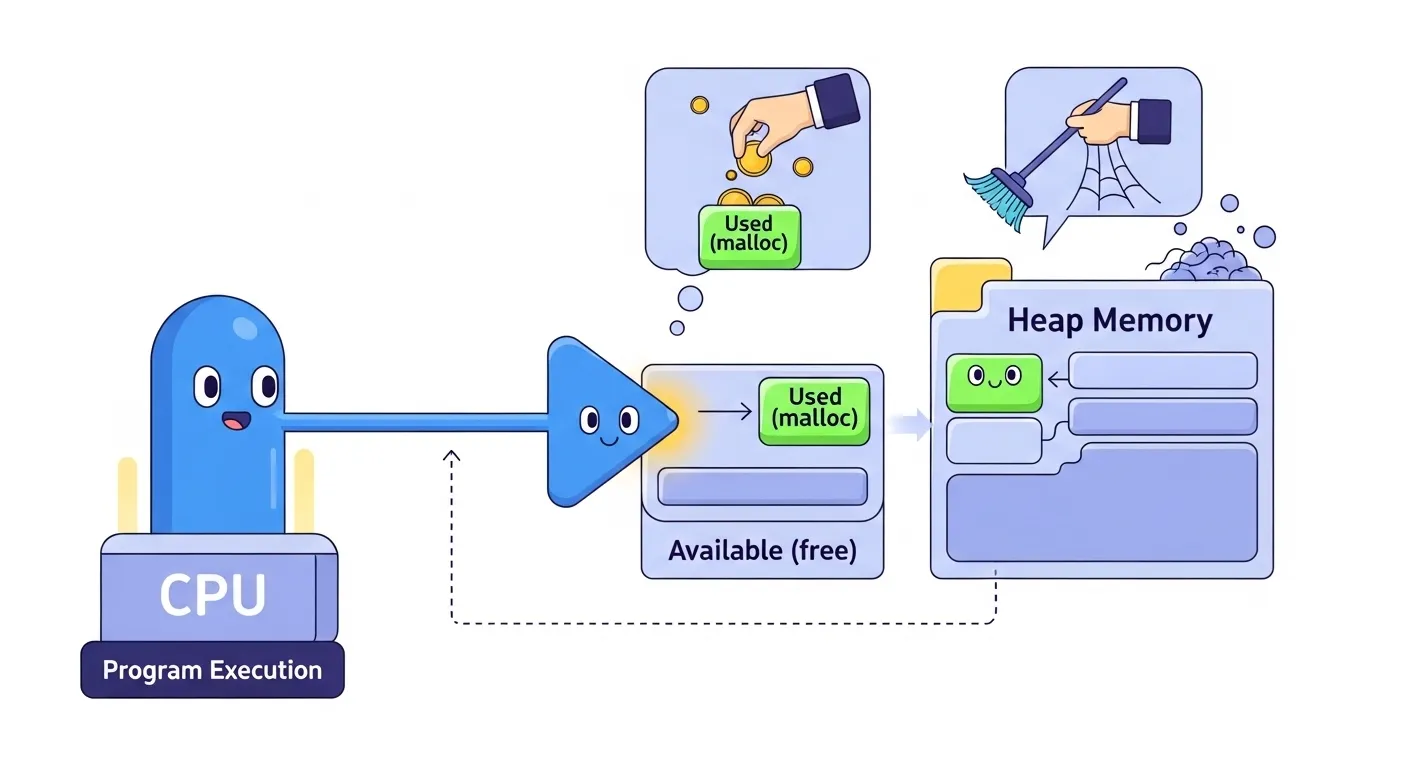
If Fundamentals was the warm-up, welcome to the heavyweight division. In C interviews — especially for embedded and systems programming — pointer questions are where interviewers try to separate the “can write C” from the “can wield C like a scalpel.”
1. Explain pointer arithmetic.
Answer: Pointer arithmetic advances in units of the pointed-to type. For example, int *p; p + 1 moves the address forward by sizeof(int) bytes, not 1 byte.
Why they ask: Ensures you understand type-size implications and array traversal.
Pro tip: Mention how void* can’t be directly incremented — it’s a GNU extension in some compilers.
2. What is void* and how is it used?
Answer: void* is a generic pointer type in C. It can hold the address of any data type but must be cast back before dereferencing. Common in memory allocation functions (malloc).
Why they ask: Tests flexibility with type-agnostic programming.
Pro tip: Always cast explicitly in C++ but not required in C (though sometimes done for clarity).
3. Dangling pointers — what are they and how to avoid them?
Answer: A dangling pointer points to memory that has been freed or gone out of scope. Accessing it is undefined behavior. Avoid by setting pointers to NULL after freeing and keeping clear ownership rules.
4. How do you detect memory leaks in C?
Answer: Tools like valgrind, AddressSanitizer (ASAN), or custom alloc/free wrappers.
Why they ask: Shows you can handle resource management in real projects.
5. Common pitfalls with malloc/free?
-
Forgetting to
free→ leaks. -
Double
free→ undefined behavior. -
Mismatched allocation/deallocation functions (
mallocwithdelete— C++ only). -
Not checking for
NULLaftermalloc.
6. Implement a safe strcpy.
Answer:
Why they ask: Tests your ability to avoid buffer overflows.
Pro tip: Drop in strncpy caveats — it doesn’t guarantee null-termination.
7. Explain the strict aliasing rule.
Answer: The compiler assumes pointers to different types don’t point to the same memory. Violating this can lead to unexpected optimizations and bugs. Exception: char* may alias any type.
8. Show a robust strdup implementation.
Why they ask: Memory allocation + copying in one function = classic interview test.
Final pointer pro tip: In interviews, talk through ownership — who allocates, who frees, and lifetime. That signals you think like a systems engineer, not just a coder.
<a name=”ds-algo”></a> Data Structures & Algorithms in C
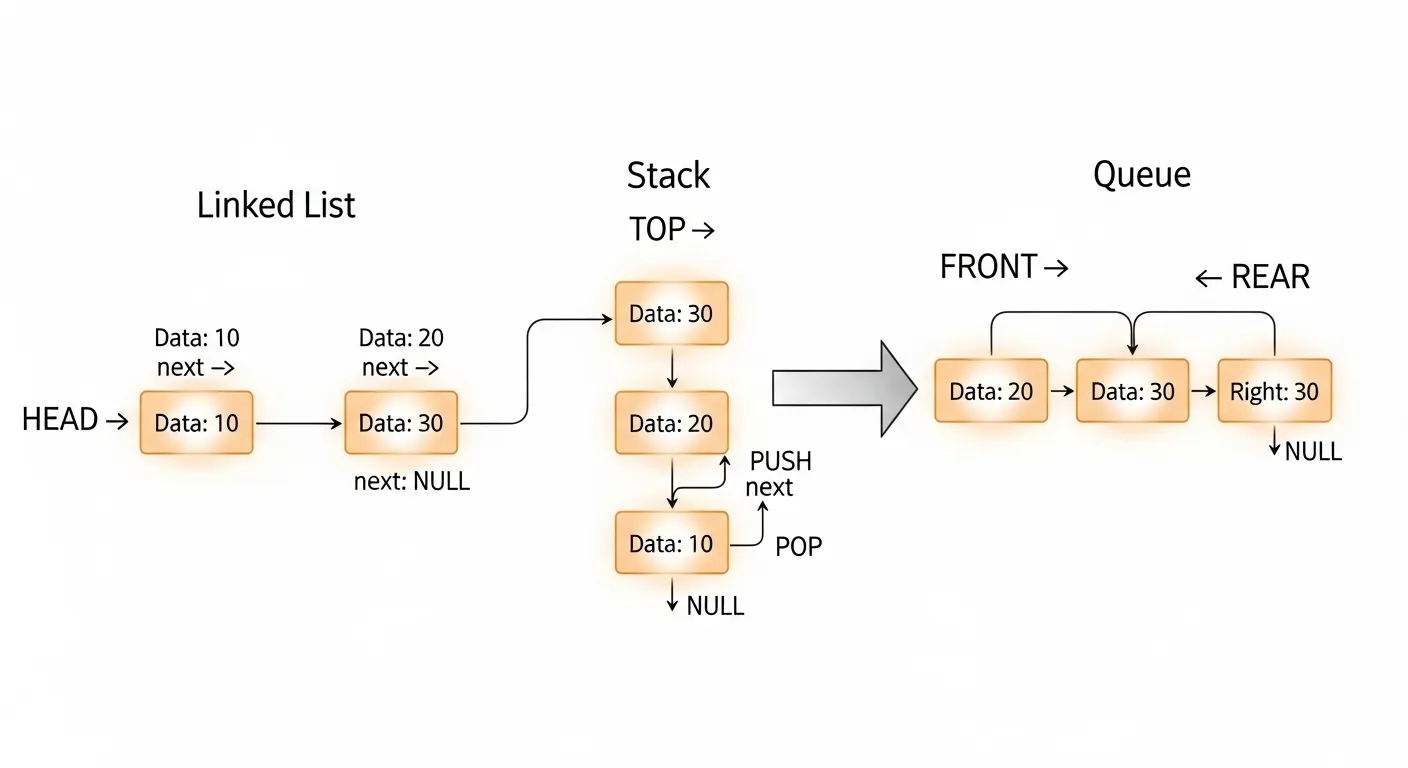
C doesn’t hand you std::vector or HashMap on a silver platter — you build them yourself.
That’s why interviewers love asking you to implement data structures from scratch, often under time pressure, to test raw algorithmic thinking and pointer mastery.
1. Implement linked list insertion.
Answer:
Why they ask: Checks pointer manipulation and memory allocation skills.
Pro tip: Mention freeing memory in real-world use to avoid leaks.
2. Dynamic array with amortized resizing.
Answer concept: Use malloc initially, double size with realloc when full.
Why they ask: Tests memory layout understanding and performance analysis.
Pro tip: Mention amortized O(1) append time and tradeoffs of realloc copying.
3. Stack implementation with arrays.
Why they ask: Basic but tests correctness under constraints.
4. Queue with circular array.
Answer concept: Maintain front, rear, and modulus arithmetic for wrap-around.
Why they ask: Common in producer-consumer scenarios.
5. Reverse a linked list in place.
Why they ask: Shows you can manipulate pointers without auxiliary data structures.
6. Simple hash table skeleton in C.
Answer concept: Array of linked lists (chaining). Hash function often uses modulo on key.
Why they ask: Checks ability to combine data structures with hashing logic.
Pro tip: Mention collision handling and load factor management.
DS/Algo interview tip: Always mention complexity (time and space) and memory implications in C, since you’re the one controlling allocation.
<a name=”concurrency-sys”></a> Concurrency & Low-Level Systems

Concurrency in C interviews isn’t just “write a thread” — it’s prove you know how to keep it from breaking everything. These questions test whether you understand memory models, atomics, and synchronization at the metal level.
1. volatile vs memory barriers?
Answer: volatile prevents certain compiler optimizations on that variable, ensuring every read/write hits memory. Memory barriers (fences) enforce ordering of operations across threads or cores — affecting CPU reordering, not just compiler optimizations.
Why they ask: Shows you understand the limits of volatile and why barriers are necessary.
2. What is the C memory model (C11 onward)?
Answer: It defines how operations on memory occur across threads — with concepts like sequenced-before, happens-before, and data race rules. Introduced in C11 with <stdatomic.h> for atomic ops.
Pro tip: Mention that before C11, multithreaded behavior was mostly “implementation-defined chaos.”
3. Atomic operations in C?
Why they ask: Checks modern C knowledge and thread-safe incrementing without locks.
4. How to avoid data races?
-
Use mutexes/locks.
-
Use atomic operations.
-
Avoid shared state when possible.
Why they ask: Looking for a prevention strategy, not just “use a lock.”
5. Locks vs lock-free programming?
Answer: Locks block threads until resources are available. Lock-free algorithms ensure at least one thread progresses, reducing contention but requiring careful atomic usage.
Pro tip: Bring up ABA problem and atomic compare-and-swap.
6. POSIX threads basics.
Why they ask: Tests real-world multithreading skills on Unix-like systems.
7. File descriptor vs file pointer?
Answer: File descriptor (int) is a low-level handle used by system calls (read, write). File pointer (FILE*) is a buffered I/O abstraction in the C standard library.
Concurrency interview tip: If asked “what can go wrong,” answer with reordering, deadlocks, and starvation — shows you’ve battled real-world multithreaded bugs.
<a name=”modern-c”></a> Modern C (C23/C18)
If you think your 1990s C knowledge is enough, think again. C23 brought the first big set of updates in over a decade, and sharp interviewers will throw in one or two “modern C” curveballs.
1. What are u8 character literals?
Answer: New in C23, u8'a' produces a UTF-8 encoded character constant of type char8_t. Useful for working with UTF-8 data explicitly.
2. Explain _BitInt(N) types.
Answer: Lets you define integers with an exact number of bits, e.g., _BitInt(17). Great for embedded and protocol code where every bit counts.
Pro tip: Mention that signedness is explicit (unsigned _BitInt(9)).
3. What is memset_explicit?
Answer: Clears sensitive data in memory without being optimized away by the compiler — important for security.
4. Purpose of char8_t.
Answer: Dedicated type for UTF-8 code units. Prevents confusion with char when handling multibyte encodings.
5. Digit separators in literals.
Answer: You can now write 1'000'000 in C23 for readability — has no effect on value.
6. Any library changes worth knowing?
Answer: New <stdbit.h> for bit operations, additions to <string.h>, and expanded attributes syntax for better compiler hints.
Modern C interview tip: Even if you haven’t used C23 in production, being aware of these changes signals that you keep up with the language, which interviewers love.
<a name=”embedded”></a> Embedded C & Real-Time
Embedded C interviews aren’t about syntax — they’re about survival in resource-constrained, timing-critical environments. These questions test your ability to think in bytes, cycles, and interrupts.
1. What’s in the startup code of an embedded C program?
Answer: Typically: stack pointer setup, initialization of .data and .bss sections, optional hardware init, and jump to main().
Why they ask: Tests low-level understanding of program boot flow before the C runtime kicks in.
2. Role of linker scripts.
Answer: Define memory layout — where code, data, stack, and peripherals live. Essential for mapping variables to specific memory addresses in embedded devices.
3. How to handle interrupts in C?
Answer: Write ISR (Interrupt Service Routines) with minimal logic, mark with platform-specific attributes (__attribute__((interrupt))), and avoid blocking calls.
Pro tip: Mention volatile for memory-mapped I/O variables modified in ISRs.
4. Why use volatile with memory-mapped I/O?
Answer: Prevents compiler from optimizing out reads/writes to hardware registers — ensures each access happens exactly as written.
5. Reducing memory footprint in embedded C.
-
Use smaller integer types where possible (
uint8_t). -
Reuse buffers.
-
Place rarely used data in non-volatile memory.
-
Remove unused library code via link-time optimization.
6. Debugging on hardware — tools?
Answer: JTAG, SWD, in-circuit emulators (ICE), serial debug logs, and occasionally blinking LEDs for last-resort debugging.
Why they ask: Shows you can debug when gdb isn’t available.
7. Example: Toggling an LED using memory-mapped I/O.
Pro tip: Mention why volatile is critical here — otherwise compiler may “optimize away” hardware writes.
Embedded interview tip: Always consider latency, footprint, and safety in your answers. A correct but slow or memory-heavy solution can be a fail in embedded contexts.
<a name=”debugging-tooling”></a> Debugging, Testing & Tooling
Great C programmers aren’t just code writers — they’re bug hunters. Interviewers love to see if you can methodically track down issues with the right tools instead of panic-printing printf everywhere.
1. How do you use gdb effectively?
Answer:
-
Compile with
-gfor debug symbols. -
Use
break,next,step,print, andwatchto inspect execution. -
Example:
2. Detecting memory errors with Valgrind.
Answer: Run valgrind --leak-check=full ./app to detect leaks, invalid reads/writes, and memory still reachable.
3. Sanitizers in C.
Answer:
-
ASAN (AddressSanitizer) → out-of-bounds, use-after-free.
-
UBSAN (UndefinedBehaviorSanitizer) → catches spec violations.
-
MSAN (MemorySanitizer) → uninitialized reads.
Example:gcc -fsanitize=address -g main.c.
4. Static analysis tools.
Answer: cppcheck, clang-tidy, or compiler warnings (-Wall -Wextra).
Pro tip: Mention you use these before code review — it shows proactive bug prevention.
Debugging interview tip: If asked “how would you debug X?”, answer with a step-by-step plan, not just a tool name. Process thinking scores major points.
<a name=”performance”></a> Performance & Optimization
Performance in C interviews isn’t about premature optimization — it’s about knowing how to measure, where to tweak, and when to stop.
1. Optimizing loops
Answer: Minimize work per iteration, reduce unnecessary calculations, and hoist invariants out of loops.
Example:
2. Cache locality
Answer: Arrange data in contiguous memory to avoid cache misses.
-
Prefer arrays over linked lists for frequent iteration.
3. Branch prediction
Answer: Minimize unpredictable branches. Use likely/unlikely hints if available:
4. Inlining & intrinsics
Answer: Inline small hot functions (inline keyword) and consider compiler intrinsics for CPU-specific instructions — but only after profiling.
5. Measuring performance
Answer: Use perf (Linux), clock_gettime(), or hardware counters to profile before and after changes.
Interview tip: Structure your answer as: Measure → Identify → Optimize → Verify. This makes you sound like a disciplined engineer instead of a “code guesser.”
<a name=”behavioural-design”></a> Behavioural & System-Design for C Roles
Even in a hard-core C interview, you’ll face behavioural and design questions. They’re not just fluff — they reveal your problem-solving process, team skills, and how you think about tradeoffs in real-world systems.
1. Describe a tricky bug you fixed
Answer framework: Use the STAR method (Situation → Task → Action → Result). Mention the debugging tools (gdb, valgrind), the root cause, and the measurable outcome (e.g., “reduced crash rate by 80%”).
2. Design a small embedded system module
Example: A temperature sensor driver.
-
Key points: modular API, interrupt handling, memory footprint.
-
Tradeoffs: polling vs interrupt-driven, portability vs hardware-specific optimizations.
3. Tradeoffs when writing portable C
-
Minimize non-standard extensions.
-
Use
stdint.htypes for predictable sizes. -
Conditional compilation for platform-specific code.
Pro tip: When interviewers ask these, they’re looking for clear structure and justification of choices — not just “what” you did, but why you chose that approach.
Code Appendix: 6 Ready-to-Run C Snippets
Below are compact, well-commented examples you can tweak in interviews or whiteboard sessions.
1. Safe String Copy (bounded)
Why it’s good: Avoids buffer overflow and ensures null-termination.
2. Simple Memory Pool Allocator Skeleton
Why it’s good: Great for embedded systems where malloc is too heavy.
3. Lock Using C11 Atomics (Spinlock)
Why it’s good: Minimal lock for very small critical sections.