

I. Introduction (AI SEO)
Remember when “Googling it” was basically a reflex? You’d type in a few words, scan a bunch of blue links, and feel like an internet detective. Fast-forward to 2025, and that detective has been replaced by something far slicker — a conversational AI that gives you the answer, not just a list of suspects.
Instead of typing “best SEO tools 2025” into Google, today’s user might just ask ChatGPT, “What are the top SEO tools right now — and which one’s worth paying for?” Boom — an instant, human-like summary, maybe even with sources cited. No scrolling, no ads, no cookie pop-ups. Just pure, AI-crafted knowledge.
Welcome to the era of AI-powered search, where “searching” is slowly being replaced by “asking.” Platforms like ChatGPT, Perplexity, Bing Copilot, and Claude aren’t just search engines — they’re answer engines. They don’t just find content; they interpret it, summarize it, and (if you’re lucky) cite it.
That tiny difference — between finding and interpreting — is the tectonic shift shaking the foundations of SEO.
For two decades, SEO has been about optimizing for keywords, backlinks, and rankings. But AI search doesn’t care about your meta tags or whether your H1 has a perfect keyword density. It cares about meaning. Context. Authority. Truthfulness. It’s not asking, “Which page ranks for this keyword?” It’s asking, “Which content helps me understand this topic best?”
That means the game has changed. Your visibility no longer depends solely on where you rank in Google’s search results — it depends on whether AI systems can understand, trust, and cite your content.
We’re witnessing a paradigm shift from keyword-based search → to conversational, contextual, AI-powered answers. And just like the SEO revolution of the early 2000s, there will be new winners — and plenty of confused marketers clutching their keyword spreadsheets, wondering what happened.
This new SEO era isn’t about “gaming the algorithm.” It’s about training the AI. The better your content feeds the knowledge graph — through structure, clarity, and credibility — the more likely you’ll show up in AI-generated answers.
In this guide, we’ll break down the evolution of AI-powered search, show you how to optimize your content for AI systems, explain entity-based SEO (it’s not as scary as it sounds), and outline how to future-proof your brand in the era of AI search optimization.
By the end, you won’t just be chasing rankings — you’ll be teaching the machines to quote you.
II. Understanding the Rise of AI-Powered Search
Imagine telling someone in 2003 that one day, we’d stop “searching” and start chatting with machines about our problems — and those machines would summarize the entire internet for us in seconds. You’d get the same look you’d give a marketer who still measures success by “keyword density.”
Yet here we are, in the age of AI search engines, where your new research assistant might have a name — ChatGPT, Perplexity, Claude, or Bing Copilot.
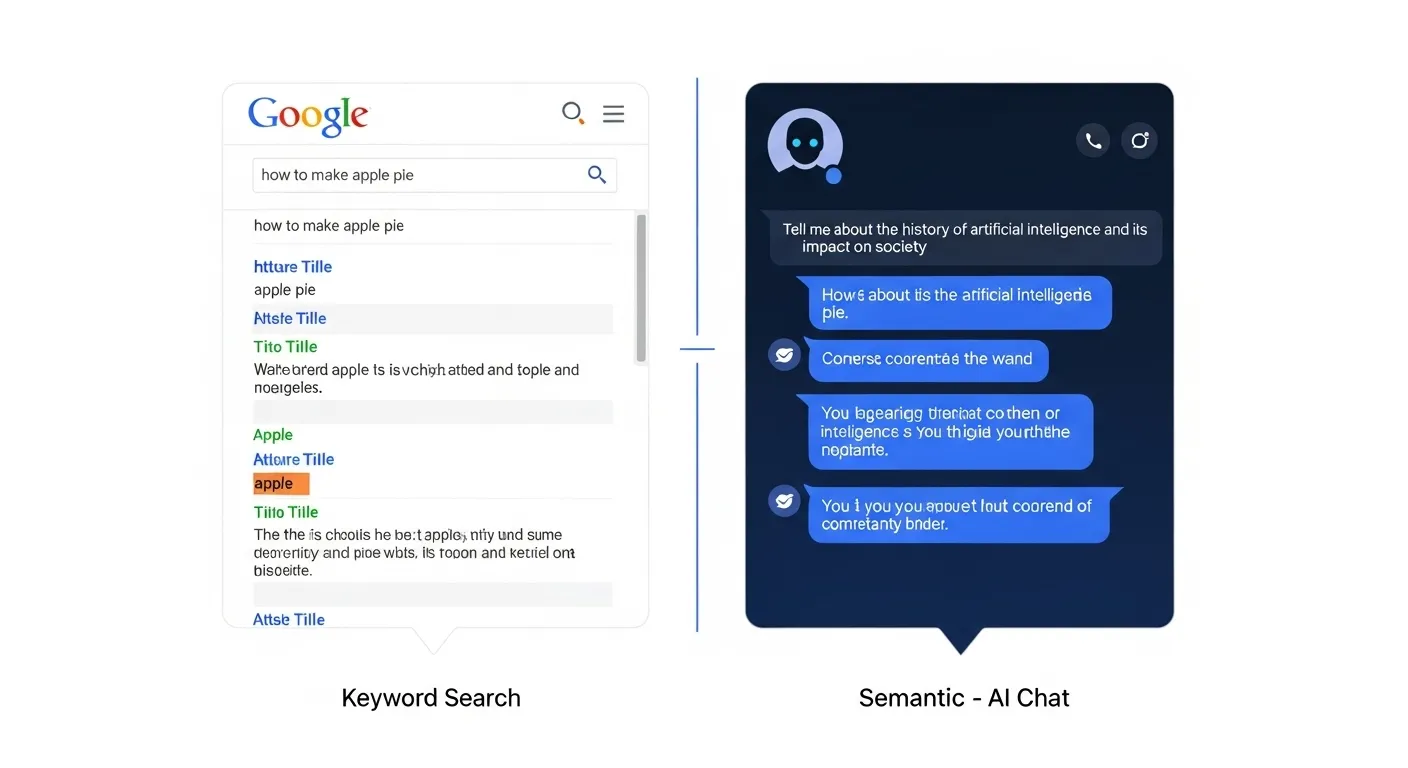
The Evolution of Search Engines: From Keywords to Concepts
The story of search has always been about one thing: getting closer to how humans think.
In the early days, Google’s algorithm was basically a librarian who didn’t really read — it just counted how many times you said a word. “You said SEO tools 12 times? Perfect, you must be the expert.”
Then came semantic search, an upgrade that let search engines understand context. This was followed by BERT (2019) and MUM (2021), Google’s attempts to grasp meaning, intent, and relationships between words. These models moved search away from raw keywords toward conceptual understanding.
Now we’ve entered the Search Generative Experience (SGE) era — where AI doesn’t just fetch answers, it creates them.
The Emergence of AI Answer Engines
Tools like ChatGPT, Perplexity, Bing Copilot, and Claude represent a new breed of “answer engines.” They use large language models (LLMs) to interpret questions, pull from massive datasets, and generate human-like responses.
Here’s the big difference:
-
Traditional search engines find and list web pages.
-
AI search engines synthesize information and present it conversationally.
If Google is a librarian handing you books, ChatGPT is the librarian who’s read them all and summarizes what matters — with a dash of wit.
How AI Search Works Under the Hood
To understand AI SEO, you’ve got to peek under the hood a little. These models are powered by LLMs — massive neural networks trained on billions of text samples from the web, books, and research papers.
But here’s where it gets wild: many AI search engines now use Retrieval-Augmented Generation (RAG) — a hybrid system that first searches real-time data, then uses AI to generate a response. This means when you ask Perplexity “What’s the best AI SEO strategy?” it retrieves fresh content from the web and then crafts a coherent, summarized answer with citations.
Citations are crucial here. They’re the breadcrumbs showing where the AI pulled its data from — and for brands, they’re the new backlinks. If an AI mentions your site in an answer, that’s not just visibility; it’s AI visibility — the new frontier of digital reputation.
Why AI Search Matters for Marketers
If you’re in marketing or SEO, this shift is both thrilling and mildly terrifying. On one hand, users get faster, better answers. On the other, they’re clicking less.
In the traditional model, you optimized to get a click. In the AI model, you optimize to get a mention. Being referenced in a ChatGPT or Perplexity answer may drive fewer visits but more authority. You’re not fighting for traffic — you’re fighting for trust.
This means your content must do more than rank. It needs to be understandable, citable, and credible. LLMs look for patterns: consistent messaging, factual accuracy, and strong author or brand signals. If your content looks like it was written by 10 freelancers who never met, AI will pick someone else’s work over yours.
The implications go far beyond SEO metrics. We’re talking about a complete shift in how visibility is defined. In this AI-driven search landscape, your brand isn’t judged just by backlinks or CTR — it’s judged by how confidently an AI model can reference you in an answer.
And let’s be honest: showing up in a ChatGPT answer feels a lot cooler than being result #7 on Google page two.
So, What’s the Takeaway?
AI-powered search isn’t a passing trend. It’s the natural evolution of how humans access information — faster, more contextual, and more conversational. As marketers, our mission is no longer to manipulate algorithms but to feed intelligence to machines in ways they can learn from, trust, and cite.
In other words:
SEO used to be about ranking on search engines.
Now, it’s about being recognized by them.
Welcome to the next generation of digital visibility — where AI search optimization becomes the new north star.
III. The New SEO Mindset: Thinking Like an AI
If old-school SEO was about outsmarting Google, AI SEO is about educating it.
Think of it like raising a brilliant but slightly gullible child — the AI wants to learn, but it needs your help to understand what’s true, trustworthy, and worth citing. The question is no longer “How do I rank?” but “How do I teach AI to understand me?”

From Ranking Pages to Training AI
Let’s start with a reality check: AI models don’t “crawl” the web the way Googlebot does. They learn from vast datasets — billions of web pages, forums, research papers, and everything in between.
So, when you publish content, you’re not just writing for humans or algorithms anymore — you’re contributing to the training material of future AI models.
That means:
-
The clearer and more consistent your content, the more likely it is to be understood and reused.
-
The more structured and factual your information, the more confidently AI systems can cite it.
In other words, your job has evolved from ranking pages to training AIs on who you are and what you know.
You’re not optimizing for Googlebot — you’re optimizing for the knowledge graph.
When a user asks ChatGPT or Perplexity a question about “AI search optimization,” the AI doesn’t “rank” sites — it recalls knowledge it’s learned or retrieved. Your goal? Make sure your brand’s knowledge is part of that mental library.
E-E-A-T and Trust Signals in the AI Era
Remember when Google rolled out E-E-A-T (Experience, Expertise, Authoritativeness, and Trustworthiness)? Back then, most SEOs treated it like a vague ranking factor checklist. In the AI era, E-E-A-T isn’t just a ranking metric — it’s how AI decides what’s believable.
Here’s how it plays out:
-
Experience: Has the author demonstrated firsthand knowledge? (Reviews, case studies, personal examples.)
-
Expertise: Is the content written by someone who actually knows what they’re talking about?
-
Authoritativeness: Is the brand recognized and cited by others online?
-
Trustworthiness: Is the information fact-checked, consistent, and backed by credible sources?
AI models weigh these trust signals heavily when deciding which sources to reference. That’s why including detailed author bios, sourcing your data, and maintaining consistent brand identity across platforms (especially LinkedIn, Twitter, and your website) matter more than ever.
You’re not just convincing humans of your authority — you’re convincing machines.
Entity-Based SEO Over Keyword SEO
Now, here’s where things get spicy. Keywords used to be the backbone of SEO — the currency of visibility. But in the world of AI, entities are the new currency.
An entity is any real-world thing that AI can recognize and connect — a person, brand, topic, product, or even a concept. When AI processes your content, it doesn’t just count keywords; it builds relationships between entities in a vast knowledge graph.
Think of it like this:
If your blog talks about AI SEO, LLMs, Search Generative Experience (SGE), and ChatGPT optimization, AI doesn’t see four separate topics — it sees a web of meaning that connects you to the broader AI search ecosystem.
That’s why entity SEO beats keyword SEO every time. Instead of optimizing for “AI SEO tips,” you’re optimizing for understanding.
When your content consistently links concepts, people, and brands, AI systems see you as a trusted node in their graph — a reliable expert within a specific domain.
Structured Thinking = Structured Data
If you want to help AI connect the dots, you need to think like it does: structurally.
That’s where schema markup, FAQs, and metadata come in. Structured data tells machines exactly what your content represents.
-
Article schema: Clarifies who wrote the post and what it’s about.
-
FAQ schema: Highlights questions and concise answers — perfect for AI extraction.
-
HowTo schema: Guides AIs (and users) through clear, actionable steps.
The more structured your content, the more easily AI can interpret it — like adding subtitles to your expertise.
AI Readability: Writing for Machines and Humans
Keyword stuffing is officially dead (may it rest in peace). What matters now is AI readability — clarity, context, and coherence.
AI doesn’t respond well to fluff, jargon, or sentences that require human inference. Write like you’re explaining a concept to a bright intern: clear, confident, and context-rich.
Use headers that actually describe the section, avoid vague buzzwords, and summarize key points in short, declarative sentences.
Because when you do that, you’re not just helping readers — you’re helping LLMs parse and remember your content.
Bottom Line
The new SEO mindset isn’t about “tricking” AI — it’s about training it.
You’re no longer optimizing for a search result — you’re building a digital reputation that machines understand, respect, and reuse.
Or to put it simply:
“If you want AI to talk about you, write like you’re teaching it.”
IV. How to Optimize Content for AI Search Engines

Welcome to the practical side of the revolution — where “AI SEO” stops being a buzzword and starts being your competitive advantage.
We’ve already established that AI search engines like ChatGPT, Perplexity, and Bing Copilot don’t “rank” content — they understand, summarize, and cite it. So the real challenge isn’t about being found by algorithms anymore — it’s about being understood by machines smart enough to read between the words.
Let’s unpack how to actually do that.
1. Optimize for Source Attribution (a.k.a. Get Cited by the Machines)
If backlinks were SEO gold in 2015, AI citations are the platinum of 2025.
AI answer engines decide which sites to mention based on credibility, formatting, and transparency. Perplexity, for example, actively cites its sources; Bing Copilot includes links in its summaries; and even ChatGPT (in some versions) provides references when connected to live search.
To boost your chances of being cited:
-
Be unambiguously factual. Include statistics, expert quotes, and up-to-date data.
-
Use original research or unique insights. AIs prefer sources that add new knowledge to the dataset.
-
Format your content clearly: numbered lists, subheadings, and clean layouts help AI extract context.
-
Keep your brand name, author, and publication date visible — AIs trust transparency.
Think of it like AI journalism — if your content looks like a credible, quotable source, you’ll get cited like one.
2. Enhance Topical Depth and Semantic Coverage
Gone are the days when you could rank with one 1,000-word blog about “AI SEO.” AI engines now look for comprehensive topical coverage — a web of interconnected pages that demonstrate expertise.
This is where topic clustering comes in.
A cluster strategy means you build a pillar page (like “AI Search Optimization Guide”) and link it to supporting pages on subtopics — like “Entity SEO,” “RAG in Search,” and “E-E-A-T for AI.”
Each page reinforces the other, signaling to AI models that your site isn’t just keyword-rich — it’s conceptually rich.
You can also use NLP tools like SurferSEO, MarketMuse, or Clearscope to analyze semantic gaps. These tools highlight related terms and entities that LLMs associate with your topic. For instance, if you’re writing about AI visibility, it might suggest including related entities like Perplexity citations or knowledge graph optimization.
By covering topics holistically, you’re basically building a mini knowledge graph that AIs can easily digest.
3. Use Clear, Concise Answer Structures
AI systems love structured answers — bullet points, definitions, tables, and short summaries. Why? Because they’re easy to extract and summarize in AI-generated responses.
Here’s how to make your content “AI-snippet-ready”:
-
Start with a direct answer. (“AI SEO is the practice of optimizing content to be understood and cited by AI systems like ChatGPT or Perplexity.”)
-
Follow with supporting context. Explain why it matters or how it works.
-
Use tables and lists for comparisons or frameworks — AIs parse them easily.
-
Include “What,” “How,” and “Why” sections. It mirrors the Q&A structure AIs are trained on.
Basically, write your content like you’re feeding it to an overachieving student who’s summarizing everything for a presentation.
4. Strengthen Author and Brand Signals
AI doesn’t just analyze words — it looks at who said them.
The more consistent your author identity and brand voice, the more trustworthy you appear to AI models. This is part of what we call “entity linking.”
Here’s how to build strong author signals:
-
Author bios: Include credentials, experience, and links to verified social profiles.
-
Cross-platform consistency: Align your name, brand, and content tone across LinkedIn, your website, and guest articles.
-
Citations & backlinks: Still matter, but more for validation than ranking.
-
Publishing frequency: Regular, high-quality posting trains AI that you’re an active authority — not a one-hit wonder.
Over time, this builds your brand entity in the eyes of LLMs — a digital fingerprint of your expertise.
5. Implement Structured Data and Schema Markup
Yes, schema markup is still about as thrilling as watching paint dry — but it’s also the backbone of machine readability.
Schema tells AIs what your content is rather than letting them guess. Think of it as labeling your boxes before you move — it makes unpacking (and understanding) faster.
The must-haves:
-
Article schema: Defines authorship, date, and topic.
-
FAQ schema: Perfect for AI question extraction.
-
HowTo schema: Enhances instructional content.
-
Product schema: Great for eCommerce and reviews.
Even organization and person schema can help establish your entity’s legitimacy.
Pro tip: Use tools like Schema.org, Google’s Structured Data Markup Helper, or Mermaid Schema Generator to automate this step — no need to code manually (unless you’re into that sort of thing).
6. Optimize for Conversational Queries
AI search is inherently dialogue-based. Users aren’t typing “best SEO tools 2025” anymore — they’re asking, “What’s the best SEO tool this year for small businesses?”
To align with this, write for natural language queries.
-
Include long-tail questions as subheadings.
-
Use FAQ sections to mimic real conversations.
-
Anticipate follow-up questions AI might ask — e.g., if you answer “What is AI SEO?” also address “How does it work?” and “Is it better than traditional SEO?”
Optimizing for conversational queries also helps you show up in voice search and AI assistant responses — two rapidly growing visibility channels.
7. Build Multi-Format Authority
Here’s a fun fact: LLMs don’t just train on text — they’re increasingly learning from multi-format content like podcasts, YouTube transcripts, PDFs, and webinars.
So if you’re only publishing blog posts, you’re leaving authority (and AI visibility) on the table.
Expand your content formats:
-
Record podcasts or YouTube discussions and publish the transcripts.
-
Turn blogs into LinkedIn carousels or short-form video summaries.
-
Upload research papers, whitepapers, or slide decks in public repositories.
Every format adds a new data point to your knowledge footprint — reinforcing your expertise across different contexts.
In short: Be everywhere the machines can learn.
Bonus: The Human Layer Still Wins
Amid all this talk about algorithms, schema, and entity graphs, it’s easy to forget that humans are still the end audience.
AI might generate the answers, but those answers are judged by people. So keep your tone relatable, your examples real, and your storytelling human.
After all, AI models are trained on human language — and the more human your content feels, the more “learnable” it becomes.
The TL;DR Playbook for AI Search Optimization
If you remember nothing else, remember this 10-second summary:
-
Be credible, not clickbaity.
-
Build topic clusters, not random blogs.
-
Use structured data like it’s your digital résumé.
-
Write in clear, conversational language.
-
Get your author entity recognized.
-
Create in multiple formats.
-
Make your content easy for AI to quote.
Because in the AI search era, you’re not just optimizing for discovery — you’re optimizing for understanding.
The new SEO question isn’t “How do I get clicks?”
It’s “How do I get cited by AI?”
V. Beyond Keywords: Data, Entities, and Knowledge Graphs
If the last decade of SEO was about chasing keywords, the next one is about training the machines to understand meaning.
Let’s be honest — keywords are like Tinder bios: they tell you something, but they don’t reveal the whole picture. AI search engines don’t just look for matching words; they look for relationships between ideas, brands, people, and topics.
Welcome to the world of entity SEO — the foundation of AI search optimization.

What Are Entities in SEO (and Why They Matter Now)
In SEO-speak, an entity is any clearly defined thing — a person, place, product, company, or even an abstract concept — that search engines can recognize and connect to other things.
For example:
-
“OpenAI” is an entity (a company).
-
“ChatGPT” is an entity (a product).
-
“AI SEO” is an entity (a concept).
-
“Perplexity” is both a company and an entity related to “AI search engines.”
When AI reads your content, it’s not scanning for keywords like a tired intern with a highlighter. It’s building mental connections between these entities — essentially asking, “How does this thing relate to that thing?”
If your brand or content consistently appears in connection with specific topics or entities, AI starts mapping you as part of that conceptual network. That’s how authority gets built in the AI era.
Knowledge Graphs and How AI Uses Them
Remember Google’s “Knowledge Graph” launched in 2012? That was the first step toward teaching search engines about the relationships between entities.
AI models have taken that concept and run a marathon with it.
A knowledge graph is basically a massive, interconnected web of entities and relationships. AI models (like ChatGPT or Bing Copilot) use these graphs to understand context — not just what something is, but how it fits into the broader world.
For instance, when a user asks:
“What is AI search optimization, and how does it relate to SGE?”
The AI doesn’t just pull text with matching keywords. It connects entities:
AI Search Optimization → SEO → Search Generative Experience (SGE) → Google’s AI initiatives → Web content citing AI SEO experts.
If your content is consistently part of that entity web — say, by linking related topics or being mentioned in discussions about them — you become part of the AI knowledge ecosystem.
That’s the holy grail of AI visibility.
Building Your Own “Topical Graph”
Here’s the fun part: you can engineer your way into the knowledge graph.
Start by building a topical graph on your own site — a network of interconnected content pieces that collectively demonstrate authority on a specific theme.
Here’s how:
-
Choose a core topic: (e.g., “AI Search Optimization”).
-
Identify subtopics: (“Entity SEO,” “LLM optimization,” “SGE ranking,” “AI citations”).
-
Create individual posts for each subtopic.
-
Interlink them logically — each one should reference and link to the others.
-
Add structured data (schema) to make those relationships machine-readable.
This creates a semantic “map” that AI systems can interpret — positioning your site as a credible source for that entire topic cluster.
In short: if Google and ChatGPT built a knowledge graph, you can build a mini one for your own brand.
Tools for Entity Optimization
You don’t have to guess how AI sees your entities — there are tools for that.
-
Google’s NLP API: Analyzes your text and shows which entities it recognizes and how it classifies them (person, organization, concept, etc.).
-
InLinks: Specializes in entity-based SEO. It helps identify missing entities and suggests internal links to strengthen your topical connections.
-
Semrush Topic Research: Helps uncover related topics and entities you can add to expand your coverage.
You can also use Wikipedia and Wikidata as reference points — many AIs cross-check their knowledge bases with these sources. If your brand (or authors) appear there, it massively boosts trust and entity recognition.
Beyond Keywords: Why It’s a Paradigm Shift
Here’s the truth bomb: keywords are how you talk to search engines; entities are how you teach them.
When you optimize for entities, you’re not just chasing visibility — you’re shaping the narrative of how AI understands your expertise.
Think of it like being part of a digital Wikipedia for your industry. The more clearly AI can map your relationships — between topics, brands, and authors — the more confidently it can cite you.
That’s the future of AI-driven search and knowledge graph SEO:
You don’t just rank. You become part of the knowledge.
VI. Metrics and KPIs in the AI SEO Era
If there’s one thing SEO pros love more than ranking #1, it’s showing a client a graph that goes up and to the right. 📈
But here’s the catch — in the age of AI search optimization, that traditional graph might not tell the whole story anymore.
Because when users get their answers directly from ChatGPT, Perplexity, or Bing Copilot, the old-school metrics like “organic clicks” and “average position” start losing their meaning.
So, how do you measure visibility when your readers never actually click?
Traditional vs. AI-Era SEO Metrics
Let’s start with the basics:
Traditional SEO was built on three pillars — rankings, impressions, and CTR (click-through rate). You tracked where you appeared on Google’s SERP, how often, and whether anyone bothered to visit.
But AI search changes the playing field. Users now ask questions conversationally and receive synthesized, citation-based answers — often without ever seeing a search results page.
So, while traditional metrics still matter, they’ve been demoted from VIP to supporting cast.
Here’s the new hierarchy:

| Old Metric | New Equivalent | What It Tells You |
|---|---|---|
| Keyword Rank | AI Answer Presence | Whether your content appears in AI-generated responses |
| CTR | AI Citation Frequency | How often your brand is mentioned or linked in AI summaries |
| Pageviews | AI Visibility Score | Your overall presence across AI platforms |
| Backlinks | Entity Mentions & Knowledge Graph Links | How strongly AI systems connect you to related concepts |
Measuring AI Citations and Mentions
Yes, you can actually track when AIs cite you — it just takes a little creativity (and caffeine).
-
Perplexity.ai openly lists its citations. You can manually search your domain or brand name and track mentions over time.
-
Bing Copilot sometimes embeds links in answers; use a tool like Bing Webmaster Tools or Ahrefs Alerts to catch them.
-
ChatGPT (with browsing) may not always cite links directly, but users often share screenshots — monitoring social media mentions or Reddit threads can reveal where you’re being surfaced.
It’s still a messy, emerging science — but make no mistake: tracking AI citations will soon be as common as tracking backlinks.
Some marketers are even creating their own “AI Visibility Dashboards” — tracking appearances across platforms like Perplexity, Copilot, and You.com. Think of it as Google Search Console for the AI era.
User Engagement and Brand Recall
Here’s where things get philosophical: if an AI answers a question using your content, and the user remembers your brand, does it count as engagement?
Absolutely.
AI visibility isn’t about clicks — it’s about impression and recall. When users see your brand cited as a source in AI responses, it reinforces trust, even if they never land on your site.
That’s why consistent branding, author bios, and entity associations matter. When your name repeatedly appears in authoritative contexts — whether in AI answers, podcasts, or LinkedIn articles — it trains both humans and machines to associate you with credibility.
So yes, brand awareness has officially become an SEO metric.
The New SEO Success Formula
In the age of AI-driven search, success looks less like “ranking high” and more like “being recognized everywhere.”
A simplified way to think about it:
AI SEO Success = (Citations + Mentions + Contextual Authority) ÷ Confusion
If you’re cited often, across multiple AI platforms, and your content is consistent and well-structured — congratulations, you’re winning.
In the next five years, expect new KPIs like:
-
“Answer Presence Score” (how often AI systems mention you)
-
“AI Source Credibility Index” (how trustworthy your content appears to LLMs)
-
“Entity Authority Rating” (how central your brand is within a topical graph)
The good news? These metrics reward quality, depth, and expertise — the stuff great marketers have been doing all along.
The bad news? You’ll need to explain to clients why their “organic clicks” went down while their AI citations went up. (Good luck with that PowerPoint.)
VII. Future-Proofing Your SEO Strategy
If SEO were a movie, we’d be in the third act — where the hero (that’s you) realizes the rules have changed, and it’s time to evolve or fade into the search results abyss.
Because the truth is, AI isn’t just influencing search — it’s rebuilding it. And while some marketers are busy tweaking meta titles, the smart ones are already asking:
“How can I make my content future-proof for the age of AI search engines?”
Let’s future-proof your strategy before the machines rewrite it for you.
1. Content as Data, Not Just Text
Here’s the mindset shift that separates yesterday’s SEO from tomorrow’s:
Your content isn’t just writing. It’s data.
AI systems don’t see your blog post as words — they see it as structured information that either strengthens or weakens their understanding of the world.
So, instead of thinking “How do I make this rank?”, think:
“How do I make this machine-readable, reusable, and factually unambiguous?”
That means:
-
Use consistent terminology across your articles.
-
Include structured data (schema) wherever possible.
-
Avoid vague statements — back claims with facts, numbers, or examples.
When AI scrapes, trains, or retrieves your content, these elements help it interpret you as a reliable data source, not a content farm.
The future winners in SEO aren’t the loudest — they’re the clearest.
2. The Role of APIs and Knowledge Bases
We’re heading toward a world where websites won’t just display content — they’ll feed data directly into AI ecosystems through APIs and open databases.
Companies like Google, Perplexity, and Anthropic (Claude) already pull structured data from sources like Wikipedia, Wikidata, and OpenStreetMap. The next frontier? Businesses providing their own verified data feeds to AI systems.
Imagine having a public-facing knowledge base that AI tools can tap into. For example:
-
A health company maintaining a verified “AI factsheet API.”
-
A SaaS company publishing product details in machine-readable form.
-
A marketing agency offering an open dataset of campaign benchmarks.
That’s where AI search optimization is heading — from ranking content to integrating knowledge.
So, future-proof step #1: Treat your content as a dataset.
Step #2: Find ways to make that dataset accessible, structured, and credible enough for AIs to trust.
3. Human-AI Collaboration in SEO
Let’s be clear — AI isn’t replacing SEOs; it’s replacing bad SEOs.
The best marketers will learn to collaborate with AI tools, using them not as a shortcut, but as strategy amplifiers.
For example:
-
Use ChatGPT or Claude to brainstorm topic clusters.
-
Use SurferSEO or MarketMuse to analyze entity coverage.
-
Use AI summarizers to turn blog posts into micro-content for social media.
In this partnership, humans bring creativity, storytelling, and emotional insight — things AI can’t fake (yet). Machines bring scale, structure, and data precision.
Together, you get supercharged strategy.
As one witty marketer said:
“AI won’t take your job. But the marketer who knows how to use AI will.”
4. Predictions for the Next 5 Years
Alright, grab your digital crystal ball — here’s what’s coming:
a. Vertical AI Search Engines Will Dominate.
We’ll see specialized AI engines for every niche — law, healthcare, finance, marketing — each trained on domain-specific data. Optimizing for these will be like SEO in 2008 all over again, except faster and weirder.
b. Personalized AI Assistants Will Curate Content.
Forget generic rankings — your “AI twin” will decide which sources you see based on your preferences and history. That means your brand must be recognizable, consistent, and contextually trusted across multiple touchpoints.
c. Answer Monetization Will Emerge.
Expect a future where AIs credit, compensate, or license answers from trusted publishers. (Yes, “AI ad revenue sharing” could become a thing — call it GenAIAds.)
d. Content Authenticity Will Matter More.
As synthetic content floods the web, verified human expertise — backed by real experience and citations — will rise in value. Think of it as the E-E-A-T renaissance.
5. Future-Proofing Checklist

To wrap this up neatly, here’s your survival kit for the coming AI SEO decade:
✅ Structure your content like data.
✅ Build topical clusters and interlinked entity graphs.
✅ Use schema markup obsessively (but efficiently).
✅ Create multi-format content — blogs, podcasts, transcripts.
✅ Build and maintain a visible author identity.
✅ Consider developing a public knowledge base or data API.
✅ Leverage AI tools to scale insights, not replace creativity.
Because let’s face it — the search game isn’t ending. It’s just evolving into something smarter, faster, and infinitely more conversational.
And those who embrace it now won’t just adapt — they’ll lead the machines.
VIII. Conclusion: Adopting the New SEO Mindset
If you’ve made it this far, congratulations — you’ve officially survived the existential crisis known as “The Future of SEO.”
The search landscape has changed before (remember when we used to stuff keywords like “best pizza New York cheap hot deals 2020” into meta tags?). But this time, the shift is deeper. It’s not just about ranking pages — it’s about teaching machines how to understand your expertise.
Welcome to the AI search era, where visibility isn’t earned through backlinks alone, but through credibility, structure, and clarity.
From Ranking to Understanding
Traditional SEO asked:
“How can I get to the top of Google’s results?”
The new SEO asks:
“How can AI best represent my expertise to users?”
The goal isn’t just to appear on a screen — it’s to become part of the machine’s knowledge. When ChatGPT, Perplexity, or Bing Copilot cite your brand, it means you’ve crossed the digital Rubicon: your content is now trusted enough to teach an AI system.
And that, my friend, is the new version of “going viral.”
The Mindset Shift
To win in this new landscape, you need to think less like an optimizer and more like an educator.
-
You’re not feeding Google — you’re training intelligence.
-
You’re not writing for clicks — you’re building contextual trust.
-
You’re not just optimizing — you’re organizing knowledge.
In short: stop chasing algorithms and start collaborating with them.
Because in the end, AI search isn’t the death of SEO — it’s its next evolution.
The Final Thought
The winners in the AI search era will be those who teach the machines well — brands, creators, and thinkers who communicate clearly, cite responsibly, and build digital reputations that can stand up to both human scrutiny and algorithmic curiosity.
So as you optimize your next piece of content, don’t just ask:
“What will rank?”
Ask instead:
“What will last?”
Because the future of SEO isn’t about search results — it’s about being remembered by the machines that shape them.